
In short: Ayurvedic postnatal care at home is a set of traditional practices for the weeks after birth, usually oil massage, warm herbal baths, abdominal binding, light warm food and rest. Many mothers find it comforting. Research has not shown that it speeds healing, and some therapies need to be changed or skipped after a C-section, with fever, or with any wound concern. Choose care that a doctor oversees and that sits alongside your own obstetrician’s advice.
Ayurvedic postnatal care at home appeals to many families because it feels familiar. It echoes what a grandmother or aunt might once have done during the first forty days. It also raises fair questions. What does it actually include? Is it safe after a C-section? How much is tradition, and how much is evidence? And how do you tell a careful provider from a careless one?
This guide answers those questions plainly. It goes deeper on the Ayurvedic side than our general guides to postnatal care at home and the 40 days after delivery. This is information, not medical advice. Your own doctor knows your delivery and your health, so their advice comes first.
What Sutika Paricharya means
Sutika Paricharya is the Ayurvedic name for care of the mother after childbirth. “Sutika” refers to a woman who has recently given birth. “Paricharya” means regimen or care. It is described in the classical Ayurvedic texts, and modern Ayurvedic papers still base their summaries on those texts.
One 2023 review in the Journal of Ayurveda and Integrated Medical Sciences describes the classical picture. The postnatal period (Sutika Kala) is about a month and a half, or until the next menstruation, in most classical authors. One author gives six months. The regimen is staged by day, and the aims include calming Vata, rekindling digestion and supporting breast milk. The same paper calls itself a conceptual study. It collects what the old texts say. It does not report patient outcomes.
The distinction matters. Sutika Paricharya is a well-developed tradition with its own logic. It is not a clinical protocol that has been tested against alternatives. Both facts can be true, and a good provider will say both.
What Ayurvedic postnatal care at home usually includes
Programmes differ from one provider to another. Here is a typical set of practices, with the traditional purpose of each. Treat it as a list of things to ask about, not a promise of results.
- Abhyanga (oil massage): warm medicated oil applied to the body, traditionally to ease stiffness and aid rest. Our guide to postnatal massage and when to start covers timing in detail.
- Vethukuli (herbal bath): a warm bath or wash with herbs, traditionally for comfort and cleanliness.
- Udara Veshtana (tummy binding): a cloth wrapped around the abdomen. See our separate piece on the tummy belt after delivery for what research does and does not show.
- Kesh Dhoopanam (hair fumigation): herbal smoke used to dry and warm the hair after a wash.
- Anjana (eye care): traditional eye care, for which a doctor’s guidance is especially important.
- Diet guidance: warm, freshly cooked, easily digested food. Our postpartum diet guide explains the usual approach.
- Extras: some families add Kizhi (a warm herbal pouch massage), face and hair packs, and baby massage or a baby bath.
Sutika Home offers these as daily home visits for 7, 14, 28 or 40 days, guided by a doctor, and adapted for normal delivery and C-section. You can read how that works on our postnatal care page.
Tradition and evidence: what we can honestly say
It helps to separate three kinds of claims.
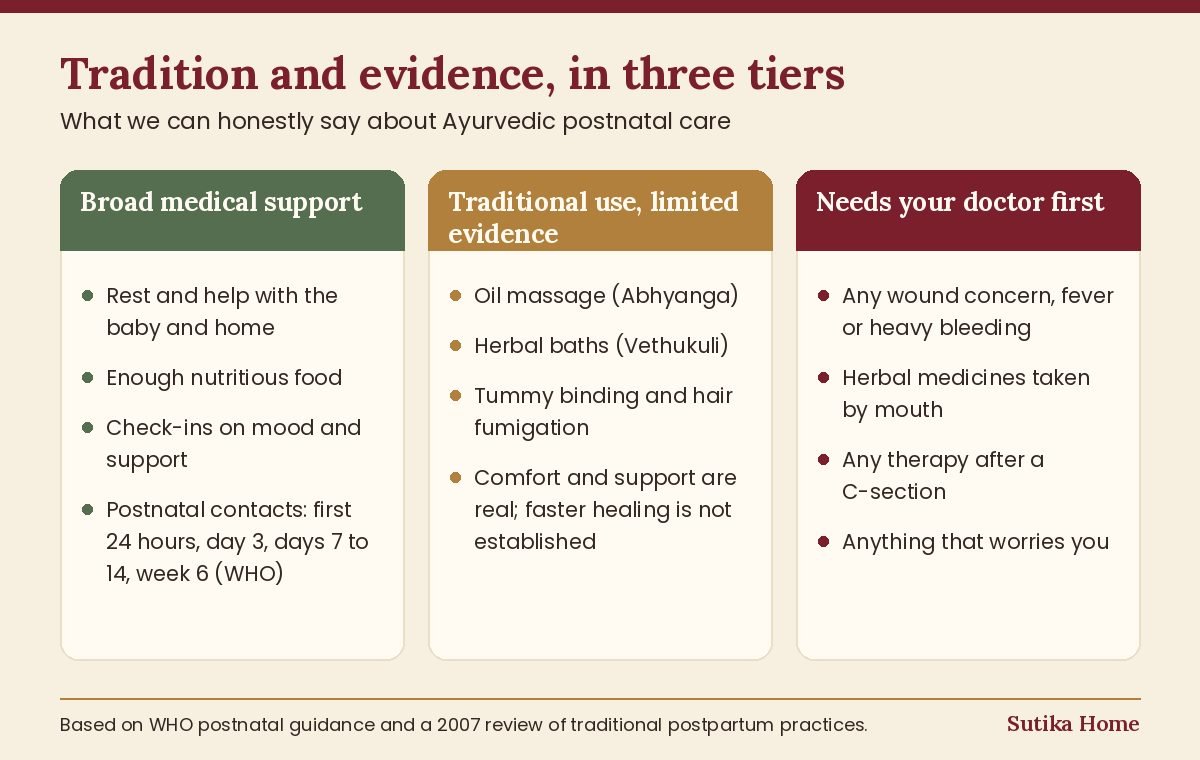
**First, things that have broad medical support.** Rest, help with the baby and household, enough nutritious food, and someone asking how you are feeling are all part of good postnatal care. The WHO recommends postnatal contacts in the first 24 hours, on day 3, between days 7 and 14, and at 6 weeks. At each one, it advises asking about emotional wellbeing and support. Ayurvedic care that includes company, rest and attention can overlap with this.
**Second, traditional practices with limited evidence.** Oil massage, herbal baths, fumigation and binding fall here. A 2007 review in Women’s Health looked at 51 studies of traditional postpartum practices from over 20 countries. It found inadequate evidence that skipping these practices causes later illness. It also noted that the practices may bring psychosocial benefits, such as support and a sense of being cared for. That is a fair summary of where things stand. Comfort and support are real. Claims of faster healing or lasting cures are not established.
**Third, anything that touches a medical concern.** A wound, a fever, heavy bleeding or a high blood pressure reading is a matter for your doctor, not a therapist. No tradition should be allowed to delay that.
Be wary of any provider who says these therapies are “proven”, “detoxify” the body or guarantee results. Pages that make such claims often give no evidence, and many do not mention who should avoid the therapies at all.
Who should adapt or skip Ayurvedic therapies
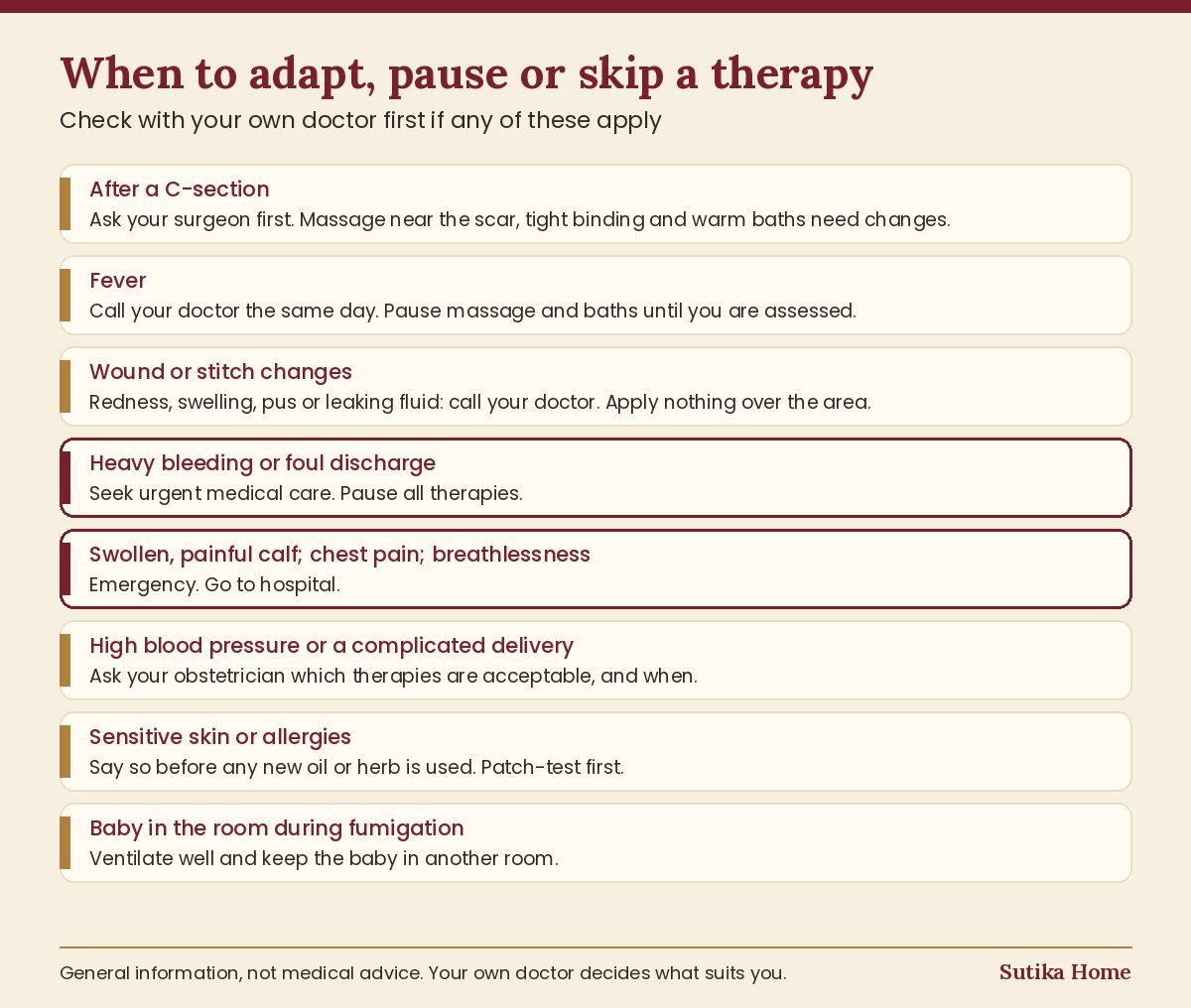
Many pages leave this part out. Postnatal therapies are not the same for everyone. Ask your own doctor before starting if any of the following applies.
- After a C-section. You have a surgical wound and are healing from major abdominal surgery. Massage near the scar, tight abdominal binding, and warm baths all need your surgeon’s go-ahead and a careful adaptation. Our C-section recovery guide explains what to expect.
- Fever. A temperature can be a sign of infection. It needs medical assessment first. Massage and herbal baths should wait.
- Wound or stitch problems. Redness, swelling, pus, leaking fluid or worsening pain at a C-section wound or perineal stitches means calling your doctor. No oil or bath should be applied over the area meanwhile.
- Heavy or unusual bleeding, or foul-smelling discharge. These need urgent medical review.
- High blood pressure, or a complicated delivery. Ask your obstetrician which therapies are acceptable and when.
- Swollen, painful calf, chest pain or breathlessness. These can signal a blood clot, which is an emergency.
- Skin conditions or allergies. Oils and herbs can irritate the skin. Say so before a patch of any new oil is used.
- A newborn nearby during fumigation. Smoke irritates the airways. The WHO links household smoke to lower respiratory infections in young children. Ask for good ventilation and keep the baby in another room during fumigation.
A careful provider asks about these things at the first visit, and asks again each day. If you are never asked how you are feeling or how your wound looks, treat that as a warning sign.
Internal herbal medicines need extra care
Everything above concerns external therapies. Some programmes also suggest herbal drinks, decoctions or tablets. These are different, because they enter your body and may pass into breast milk.
Do not start any herbal medicine without telling your doctor that you are breastfeeding. Avoid products bought online with no clear maker or ingredient list. A widely cited study in JAMA tested 193 Ayurvedic medicines bought online and found that 20.7 per cent contained detectable lead, mercury or arsenic. The rate was similar for US-made and Indian-made products, and it was higher for the group of preparations made with metals and minerals (rasa shastra). That study looked at medicines sold online in 2005, not at massage oils. Still, it is a reminder to ask exactly what you are being given.
Doctor oversight: what it should look like
“Doctor-guided” should mean something concrete. Ask for the following.
- A named doctor who sets or reviews your plan, and a way to reach them.
- An assessment before the first therapy, covering your delivery type, health history, medicines and wound.
- A clear rule for what happens if you spike a fever, bleed heavily or notice a wound change. The answer should be “we stop and you call your doctor”, not “we continue”.
- Willingness to speak to your obstetrician if you ask.
In India, practitioners of Ayurveda are meant to be enrolled in a State or National Register under the National Commission for Indian System of Medicine Act, 2020. The Act provides for a publicly available national register. You can ask a provider for the doctor’s registration details. Remember that a trained therapist who gives massage is not the same as a registered doctor. Both roles are fine. You should simply know who is who.
How to evaluate an Ayurvedic provider
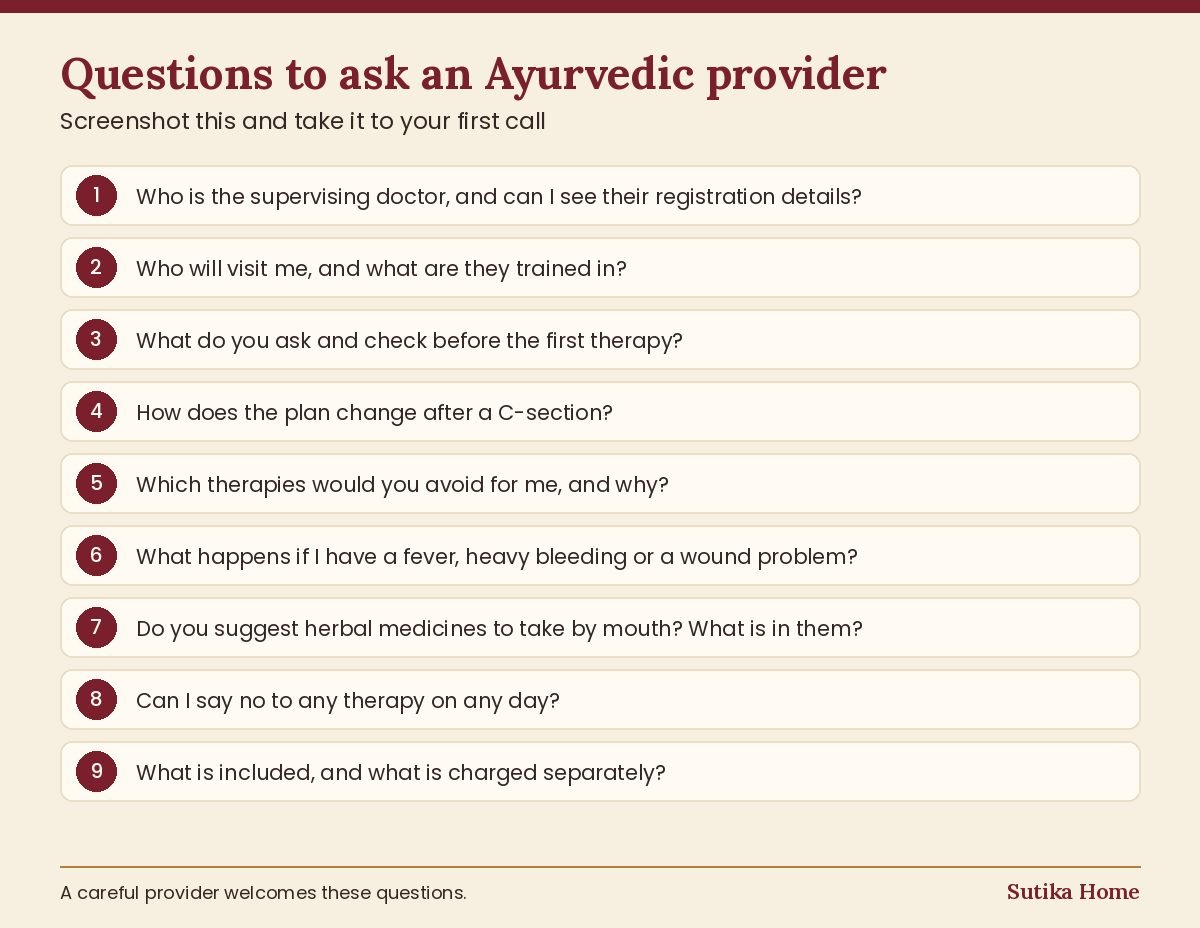
A short checklist helps you compare options calmly. The graphic below can be saved or screenshotted for your phone.
- Clarity about roles. Who is the doctor, and who is the therapist?
- Screening and adaptation. Do they ask about C-section, fever, wound, bleeding and medicines before the first visit?
- Honest language. Do they say “traditionally used for” rather than “proven to”?
- Hygiene. Clean linen, clean hands, and oil that is not reused between mothers.
- A clear plan for problems. Do they know when to stop and refer you to hospital?
- Respect for your choices. You should be able to say no to any therapy on any day without pressure.
- Transparent costs. Ask what is included and what is charged separately. Our guide to postnatal care cost lists the questions to ask.
A note for families far from home
Many families today live far from the elders who once guided the first weeks, so they look for help at home. Availability, though, is local. Providers differ in the areas they serve, the hours they work and who visits. Sutika Home’s team asks for your city and area when you get in touch, so share them early and ask what is possible where you live.
Whatever you choose, keep your regular medical follow-ups. Home care does not replace a postnatal check with your doctor.
When to get medical help without waiting
Contact your doctor or go to hospital straight away for any of these, and pause any therapy until you have been seen:
- Fever.
- Heavy bleeding, or large clots.
- Foul-smelling vaginal discharge.
- A wound that is red, swollen, leaking pus or fluid, or opening.
- Severe or worsening pain.
- A swollen, painful or warm calf.
- Chest pain or difficulty breathing.
- A severe headache or changes in your vision.
- Very low mood, or any thought of harming yourself or your baby.
The WHO guidance asks women to report signs of haemorrhage, pre-eclampsia, infection and blood clots. The Mayo Clinic adds that a wound that is red, swollen or leaking fluid should be reviewed by a healthcare professional. Do not wait for the next scheduled visit.
Before you decide
Ayurvedic postnatal care can be a gentle part of recovery. It works best when you know what each therapy is for, what it cannot do, and when it should wait. Ask who the doctor is. Ask how the plan changes after a C-section. Ask what happens if something looks wrong.
If you would like to talk through what could suit you, you can request a call back and share your delivery date, your area and your questions. You can also read about our postnatal and prenatal services first. There is no pressure either way.
Frequently Asked Questions
What is Sutika Paricharya in Ayurveda?
Sutika Paricharya is the classical Ayurvedic regimen for a woman after childbirth. It covers diet, rest, oil massage, baths and daily routines. Classical texts describe a period of about a month and a half, and some authors give longer. It is a traditional framework, and it has not been proven in clinical trials as a whole.
Is Ayurvedic postnatal care safe after a C-section?
It can be adapted, but only with your surgeon’s or doctor’s go-ahead. A C-section is major abdominal surgery, so massage near the wound, tight binding and warm baths need careful changes. A provider should ask about your wound at every visit, and stop if it looks red, swollen or is leaking.
Does Ayurvedic massage speed up postpartum healing?
There is not enough evidence to say so. A review of traditional postpartum practices found inadequate evidence that skipping them causes illness, and noted possible psychosocial benefits. Many mothers find massage relaxing, and that is a reasonable reason to choose it. Do not expect it to replace medical care.
Can I have Ayurvedic therapies if I have a fever?
No. Fever can be a sign of infection and needs medical assessment first. Pause massage, baths and other therapies, and contact your doctor the same day. A fever after birth should not be treated at home with oils or herbs. Resume only when your doctor says it is fine, and tell the provider what the doctor advised.
Are Ayurvedic herbs safe while breastfeeding?
Not all are. Herbs taken by mouth can pass into breast milk, and quality varies. Tell your doctor you are breastfeeding before taking any herbal drink or tablet, and avoid products with no clear maker or ingredient list. External oils are a separate matter, but patch-test them if you have sensitive skin.
How do I check if an Ayurvedic provider is qualified?
Ask who the supervising doctor is and for their registration details. Indian law provides for State and National Registers of Ayurvedic practitioners. Also ask what the therapist is trained in, how the plan changes after a C-section, and what the provider does if you develop a fever or a wound problem.
Can Ayurvedic care replace my doctor’s postnatal check-ups?
No. It should sit alongside them. The WHO recommends postnatal contacts in the first 24 hours, on day 3, between days 7 and 14, and at 6 weeks. Keep those check-ups, and tell your doctor which therapies you are using.
Sources
- WHO: Postnatal care for mothers and newborns, highlights from the 2013 guidelines
- WHO: Household air pollution and health, fact sheet
- Nath A, Kumar Goswami D. Sutika Paricharya, Post Natal Care in Ayurveda. J Ayu Int Med Sci, 2023
- Dennis C-L et al. Traditional postpartum practices and rituals: a qualitative systematic review. Women’s Health, 2007 (summary)
- Saper RB et al. Lead, mercury, and arsenic in US- and Indian-manufactured Ayurvedic medicines sold via the Internet. JAMA, 2008
- Ministry of Ayush: National Commission for Indian System of Medicine Act, 2020
- Mayo Clinic: C-section recovery, what to expect
Leave a Reply