

In short: A good postnatal care checklist covers five things: a ready home, people who will help, booked doctor follow-ups, feeding support, and a clear list of warning signs. Sort most of it before delivery, because you will have little energy to plan afterwards. Then review it again at the end of each week for the first six weeks.
If this is your first baby, the weeks after birth can feel like a blur. You are healing, feeding around the clock and learning a tiny person’s signals. A postnatal care checklist will not remove the tiredness. It does help you decide things calmly, while you are still pregnant, so that the first six weeks run on a plan instead of on panic.
This guide is written for first-time mothers and the families who will support them. It is general information, not medical advice. Your own obstetrician and paediatrician know your delivery and your baby, so their advice always comes first.
What to arrange before delivery
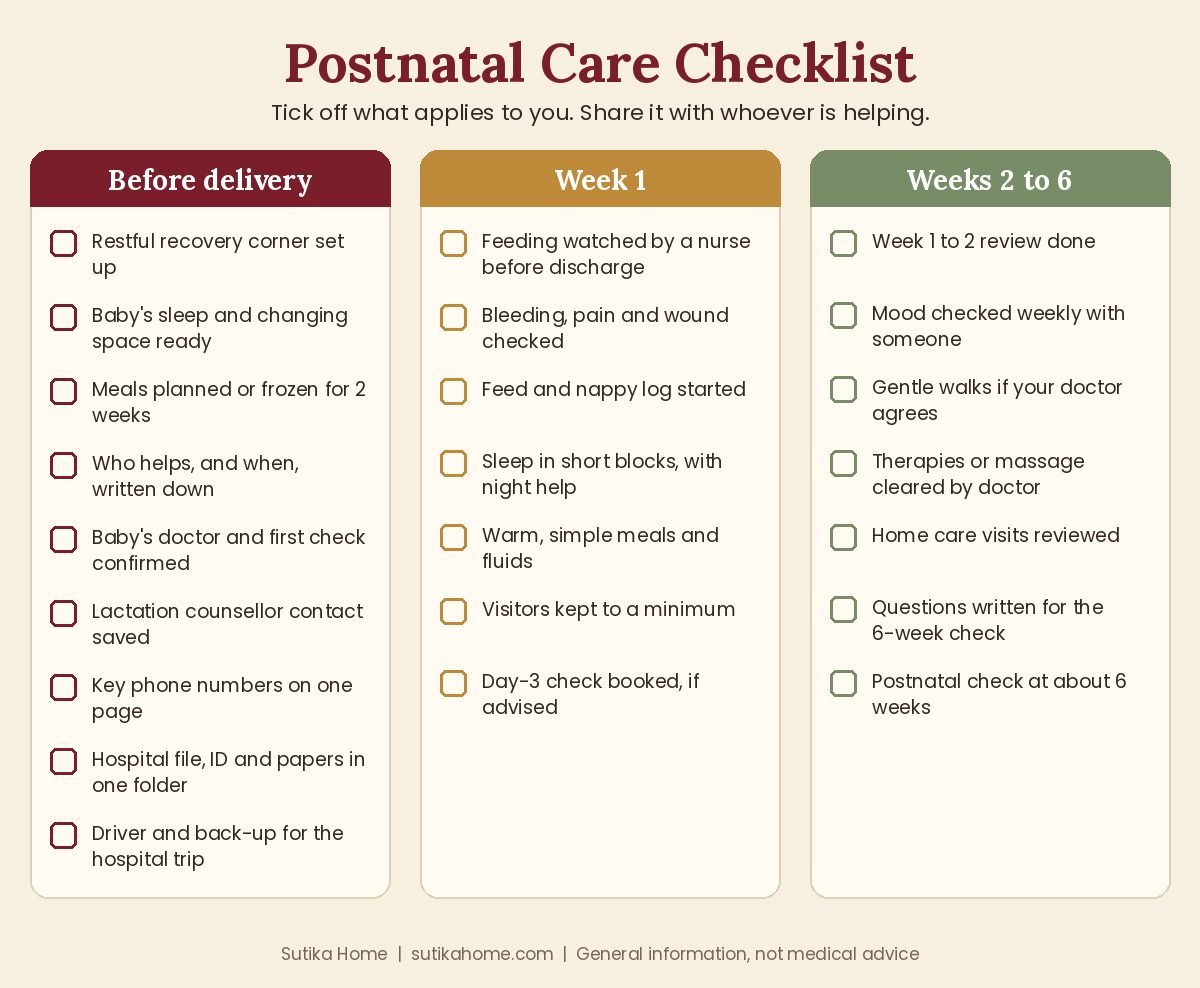
Try to finish most of this well before your due date, and earlier if your doctor has flagged any risk. These are the things worth settling first.
Set up the home
- Create a restful corner: a firm bed or sofa, a few pillows for feeding, a bedside table with water, snacks and your phone charger.
- Keep the bathroom safe and simple: non-slip mats, a stool if bending is hard, clean towels and any hygiene items your doctor recommends.
- Prepare the baby’s sleep space and a changing spot at arm’s reach, so you are not carrying the baby around more than you need to.
- Stock the pantry with the basics. Our guide to the postpartum diet in India has ideas for what to keep at home.
- Freeze or plan meals for the first two weeks, and decide who will cook.
- Keep the room warm, airy and quiet. Limit visitors in the early days.
If you are expecting a C-section, add a few extras: loose, front-opening clothes, a pillow to hold against the stitches, and a plan for stairs. Our C-section recovery guide covers this in more detail.
Line up help at home
Many first-time mothers assume family will simply step in, then find that everyone has different ideas. Talk it through early. Who cooks? Who handles laundry? Who takes the night shift so you can sleep a few hours in a row? Write the answers down and put the list on the fridge.
If grandparents or relatives are travelling in, ask them to arrive just before the due date, not weeks ahead. If nobody can come, say so honestly and look at paid help, such as a trained postnatal caregiver, a cook or a cleaner, well before delivery. We compare the options in our guide to postnatal care versus a nanny.
Book the people and the paperwork
- Confirm who your baby’s doctor will be and when the first check happens.
- Ask your obstetrician when to expect your first follow-up, and what to do if you have questions between visits.
- Find out whether your hospital has a lactation counsellor.
- Save your doctor’s number, the hospital’s emergency number and a trusted relative’s number on one page, and on your phone.
- Keep your hospital file, ID, insurance details and discharge papers in a single folder.
- Decide who will drive you to the hospital, and who is the back-up.
The first week: who checks on you and what to expect
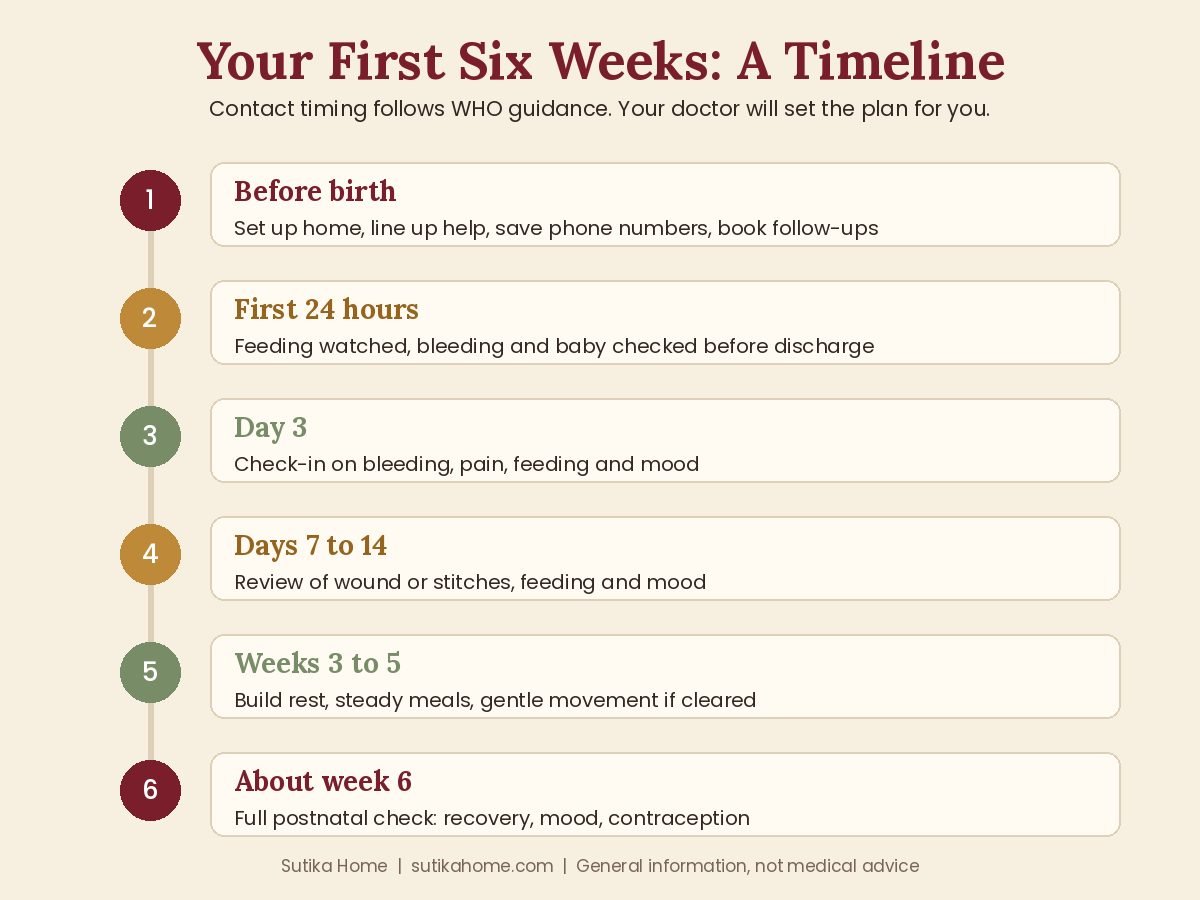
The first days are when many problems can start, and when help is most useful. The World Health Organization (WHO) recommends that healthy mothers and babies stay at least 24 hours in a health facility after an uncomplicated vaginal birth. It also suggests four postnatal contacts in the first six weeks: within 24 hours, on day 3, between days 7 and 14, and at six weeks.
In practice, how these contacts happen depends on your hospital and city. Ask your doctor before discharge which of them are booked, and which you must arrange yourself. If a check is not booked, book it before you leave.
Expect to feel sore, tired and emotional. Bleeding after birth is normal, but it should slowly lessen. Ask your doctor what is typical for you, so you can tell ordinary from worrying.
Feeding support: ask for help early
The WHO and UNICEF recommend starting breastfeeding within an hour of birth, feeding only breast milk for the first six months, and continuing up to two years or beyond. Those are recommendations, not a test you can fail. Many mothers need help with latching, positioning or worries about supply. That is normal and it is fixable.
- Ask the nurse or a lactation counsellor to watch a full feed before you leave the hospital.
- Note the name and number of someone you can call when feeding gets difficult.
- If you cannot breastfeed, or choose not to, ask your paediatrician how to feed your baby safely. You deserve support either way.
- Keep a simple log of feeds and wet nappies for the first week. Your doctor can use it.
Tell your doctor if nipples crack or bleed, if a breast is hot, red or very painful, or if your baby is feeding poorly.
Food, rest and recovery in the first six weeks
Small, regular meals and plenty of fluids are easier to manage than three large meals when you are feeding a baby. Traditional postnatal diets in India favour warm, freshly cooked food. Families value them, but traditional use is not proof that a food speeds healing. If you have diabetes, anaemia, allergies or a C-section wound, let your doctor guide what you eat.
Rest is harder than it sounds. Try to sleep when the baby sleeps, accept the night shift offer from a partner or relative, and let the housework wait. Walk gently when your doctor says it is fine. Do not lift heavy things or start exercise early without your doctor’s go-ahead.
Many families also follow the traditional “40 days” of rest. You can read how Ayurveda approaches this in our guide to the 40 days after delivery. If you are curious about oil massage or a tummy belt, ask your doctor first, then see what we have written on postnatal massage and tummy belts.
Look after your mood too
Feeling teary, anxious or overwhelmed in the first days is very common. The NHS says this “baby blues” period usually settles within about two weeks. If low mood lasts longer, gets worse, or you feel hopeless, cannot cope, or have thoughts of harming yourself or your baby, tell your doctor straight away. Postnatal depression can start any time in the first year, and it is treatable. Asking for help is not a failure.
Tell your partner or a close relative what to watch for: not eating, not sleeping even when the baby sleeps, constant worry, or pulling away from everyone.
Doctor follow-ups: a simple schedule
Use this as a conversation starter with your own doctor, not as a replacement for their plan.
- Before leaving hospital: feeding check, baby’s check, and your discharge advice in writing.
- Around day 3: a call or visit to check bleeding, pain, feeding and your baby’s colour and weight, if your doctor advises it.
- Days 7 to 14: a review of your wound or stitches, feeding and mood.
- Around week 6: a full postnatal check. NICE in the UK recommends this at 6 to 8 weeks and says it should cover mental health, physical recovery such as pelvic floor and wound healing, contraception and any ongoing conditions.
Write down your questions before every visit. A notebook beside the bed works well at 3 am, when worries seem biggest.
When to book postnatal care at home
Home care is worth considering if you have no one to help, if you are recovering from a C-section, if you live far from family, or if you simply want a trained person to check on you each day. The best time to arrange it is during the last trimester, not after the baby arrives. Providers often need notice, and you will not feel like comparing options at 2 am.
At Sutika Home, our postnatal care at home is guided by a doctor and offered as daily visits for 7, 14, 28 or 40 days, adapted for normal delivery and C-section. Visits can include Ayurveda-informed therapies such as Abhyanga (oil massage) and Vethukuli (herbal bath), plus diet guidance. These therapies draw on tradition. We adapt or skip them when your doctor advises, and they never replace medical care. See our overview of postnatal care at home for what to ask any provider, and our page on prenatal care if you want support before delivery.
Before you book anyone, ask who will visit, what they are trained in, which doctor guides the plan, and how they respond if something looks wrong. If cost matters, read how postnatal care pricing works before you compare.
Red flags: when to call your doctor straight away
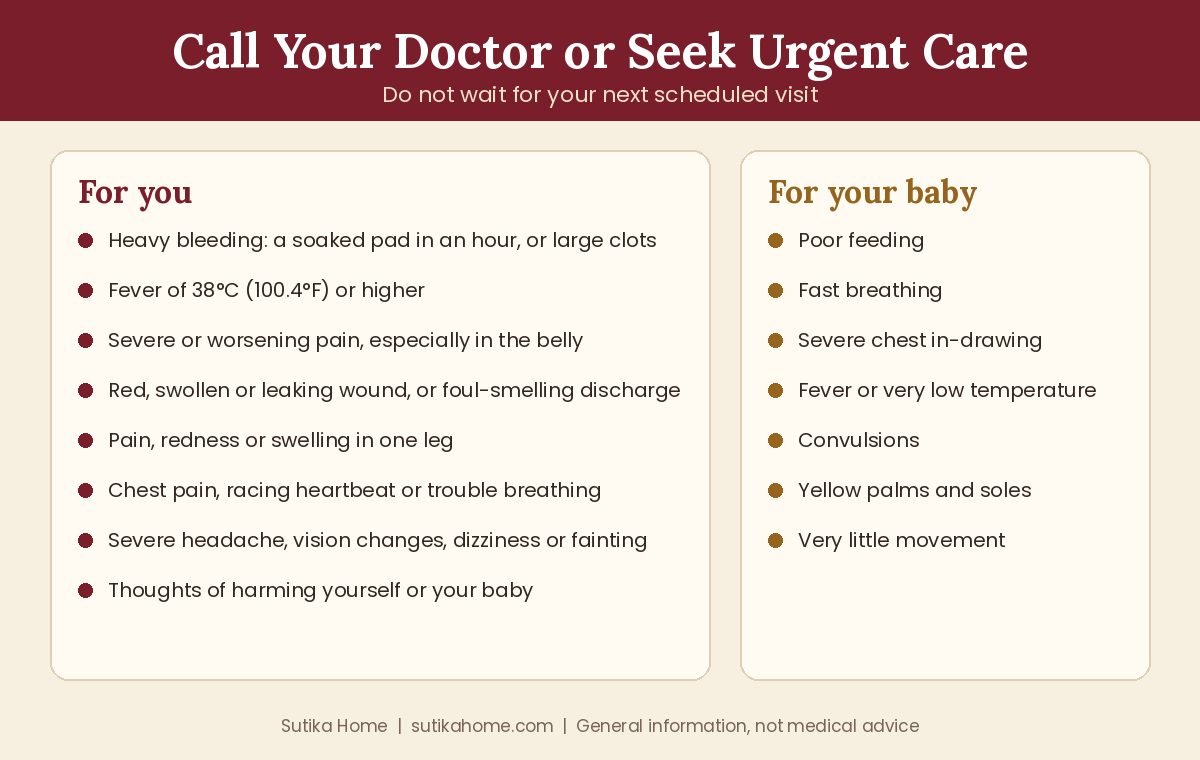
Do not wait for your next scheduled visit if you notice any of these. Call your doctor, or go to the nearest emergency department:
- Heavy bleeding, such as soaking a pad in an hour, or passing large clots
- Fever of 38°C (100.4°F) or higher
- Severe or worsening pain, especially belly pain
- A red, swollen, leaking or foul-smelling wound or discharge
- Swelling, redness or pain in one leg
- Chest pain, a racing heartbeat, or trouble breathing
- A severe headache that does not go away, or vision changes
- Dizziness or fainting
- Thoughts of harming yourself or your baby
The CDC notes that serious problems can appear in the weeks after birth, and sometimes up to a year. If something feels wrong, trust that feeling and call. For your baby, WHO lists these danger signs: poor feeding, fast breathing, severe chest in-drawing, fever, a very low temperature, convulsions, yellow palms and soles, and very little movement. Go to a doctor at once if you see any.
A short plan to keep
A postnatal care checklist works best when it is short, written down and shared. Before delivery, set up the home, line up help, save the key phone numbers and book your first follow-ups. After the birth, protect your sleep, get feeding help early and keep an eye on your mood and the red flags above.
If you would like to talk through what support could look like for your family, you are welcome to request a call back. We will ask which city and area you are in, and there is no pressure to decide. You can also read about our postnatal care and prenatal care services.
Frequently Asked Questions
What should a postnatal care checklist include?
A ready recovery space, named helpers, planned meals, booked doctor follow-ups, a feeding support contact, key phone numbers and a list of warning signs. Add a plan for your mood and sleep. Share the list with your partner or family so everyone knows their part before the baby arrives.
How many check-ups do I need after delivery?
It depends on your delivery and your doctor. WHO guidance suggests four postnatal contacts in the first six weeks: within 24 hours, on day 3, between days 7 and 14, and at six weeks. Ask your own doctor which visits are booked and which you must arrange.
When should I arrange help at home after delivery?
Do it during pregnancy, ideally well before your due date. Agree who will cook, clean and help at night. If you want paid support, such as a trained postnatal caregiver, contact providers early, because they may need notice and you will have little energy to compare options afterwards.
Is it normal to feel low after the baby arrives?
Feeling tearful or anxious in the first days is common, and the NHS says these baby blues usually settle within about two weeks. If low mood lasts longer, worsens, or you have thoughts of harming yourself or your baby, tell your doctor straight away. Postnatal depression is treatable.
When should I book postnatal care at home?
Many families book in the third trimester, so that visits can start soon after discharge. Choose a provider who explains who will visit, what they are trained in, and which doctor guides the plan. Home care supports recovery but never replaces your own doctor’s check-ups.
Which symptoms need urgent medical help?
Heavy bleeding, fever of 38°C or higher, severe pain, a red or leaking wound, a swollen painful leg, chest pain, breathlessness, a severe headache, vision changes, or thoughts of self-harm. Call your doctor or go to the nearest emergency department straight away. Do the same if your baby feeds poorly or breathes fast.
Leave a Reply