

In short: to compare postnatal care services, judge every provider on the same six things: who actually visits you, which doctor oversees the plan, how hygiene is handled, what the written package includes, what the cancellation terms are, and what happens if something looks wrong. A provider that answers all six clearly, and lets you check the answers, is usually a safer bet than one that simply sounds reassuring.
Choosing among postnatal care services is hard because the options look alike online but work very differently at home. An agency, a hospital programme, an independent therapist, an Ayurvedic centre and a doctor-guided home service can all say “postnatal care” and mean five different things. This guide gives you a plain way to compare them. It covers a short scorecard, the checks worth doing before you pay, and the warning signs that should make you pause.
We run one of the services you may be comparing, so we have kept this guide generic. It does not rank anyone and it does not quote prices. If cost is your first question, read our separate guide on what postnatal care costs.
Why postnatal care services are hard to compare
In the first weeks after birth you are healing, feeding a newborn and sleeping in short pieces. Few people have the energy to run a careful search. So decisions often get made on a phone call, a friend’s recommendation or a good-looking Instagram page.
The trouble is that “postnatal care” has no single agreed meaning in everyday use. For one provider it is a daily oil massage. For another it is a nurse visit to check your wound and your baby’s weight. For a third it is a live-in helper who also cooks. Two quotes can look similar and cover completely different work.
Many provider pages leave out the details that matter most to a buyer. Staff qualifications, doctor involvement, hygiene routines and cancellation terms are often missing or are replaced by “please call us”. That is not always a bad sign, but it means the comparison has to happen on the call, with your own questions.
For a benchmark, the World Health Organization advises that every mother and baby should have at least three further postnatal checks in the first six weeks, at 48 to 72 hours, at 7 to 14 days and at six weeks, and it encourages home visits where feasible (WHO, 2022). A private service does not replace those checks with your own doctor. It should fit around them.
The five kinds of provider you will meet
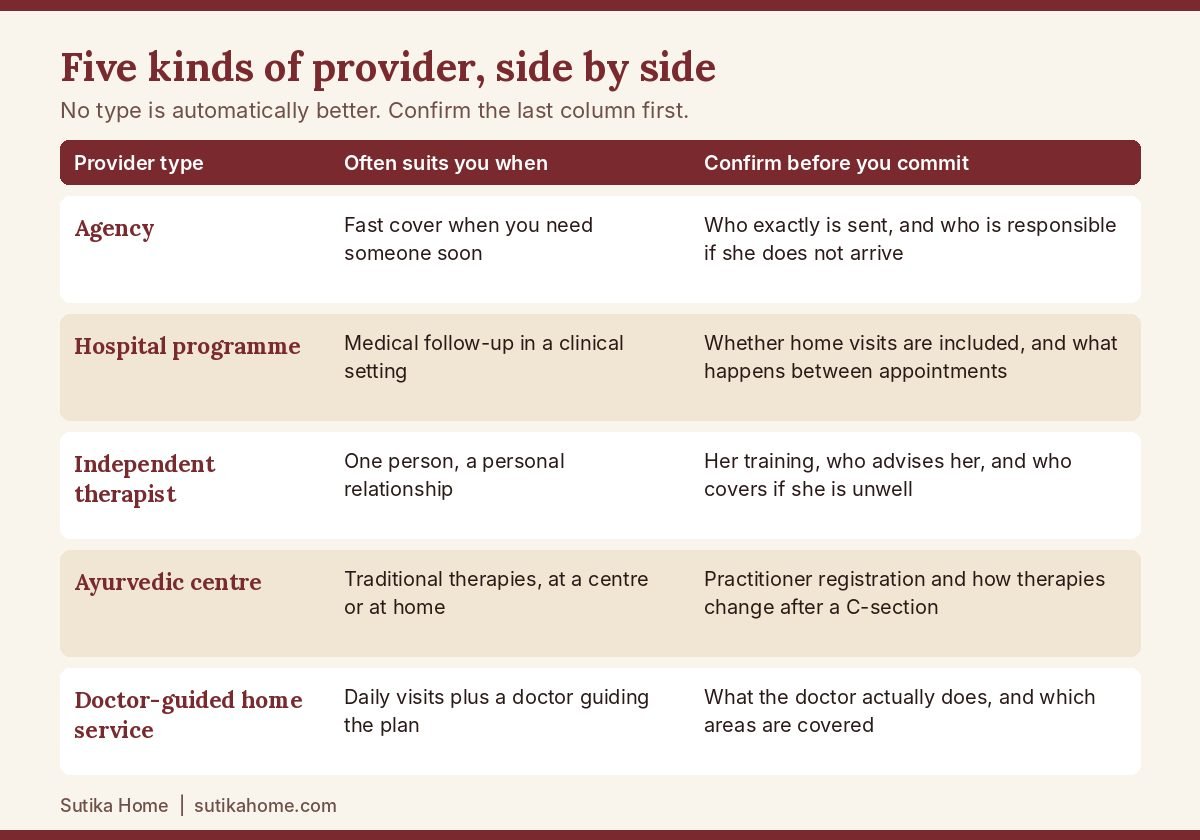
Most families in the city end up choosing between these five. None is automatically better. Each suits a different kind of household, and each has one thing you must confirm before you commit.
1. Agencies. An agency supplies a caregiver, nurse or therapist and handles scheduling. This is convenient, especially if you need someone quickly. Ask who the agency is sending, what training that person has, and whether the same person will come every day. Ask also who is responsible if she does not turn up.
2. Hospital programmes. Some maternity hospitals offer postnatal check-ups, lactation support or visit packages, often linked to your delivery package. The medical setting is a strength. What to confirm is whether the programme includes home visits at all, how many, and what happens between appointments.
3. Independent therapists. A self-employed massage or postnatal therapist can be skilled and personal. You usually deal with one person, which makes the relationship simple. The things to check are her training, who advises her if you have a complication, and what happens when she is ill or unavailable.
4. Ayurvedic centres. These offer traditional postpartum therapies such as oil massage, herbal baths and abdominal binding, sometimes at a centre and sometimes at home. Confirm the practitioner’s registration, how therapies are changed after a C-section, and whether a doctor reviews your plan. Our guide to postnatal massage and when to start explains why timing matters.
5. Doctor-guided home services. Sutika Home is in this group. Care is delivered at home by trained therapists and a doctor guides the plan. Whoever offers this model, ask to see how the doctor’s role actually works in practice, not just that it exists.
A simple scorecard you can use on every call
Write the provider’s name at the top of a page and score each line from 0 to 2. Use the same page for every provider. A score of 2 means you got a clear answer and could check it. A score of 1 means a partial or unchecked answer. A score of 0 means no answer or a vague one.
| What you are scoring | A strong answer (2) | A weak answer (0) |
|---|---|---|
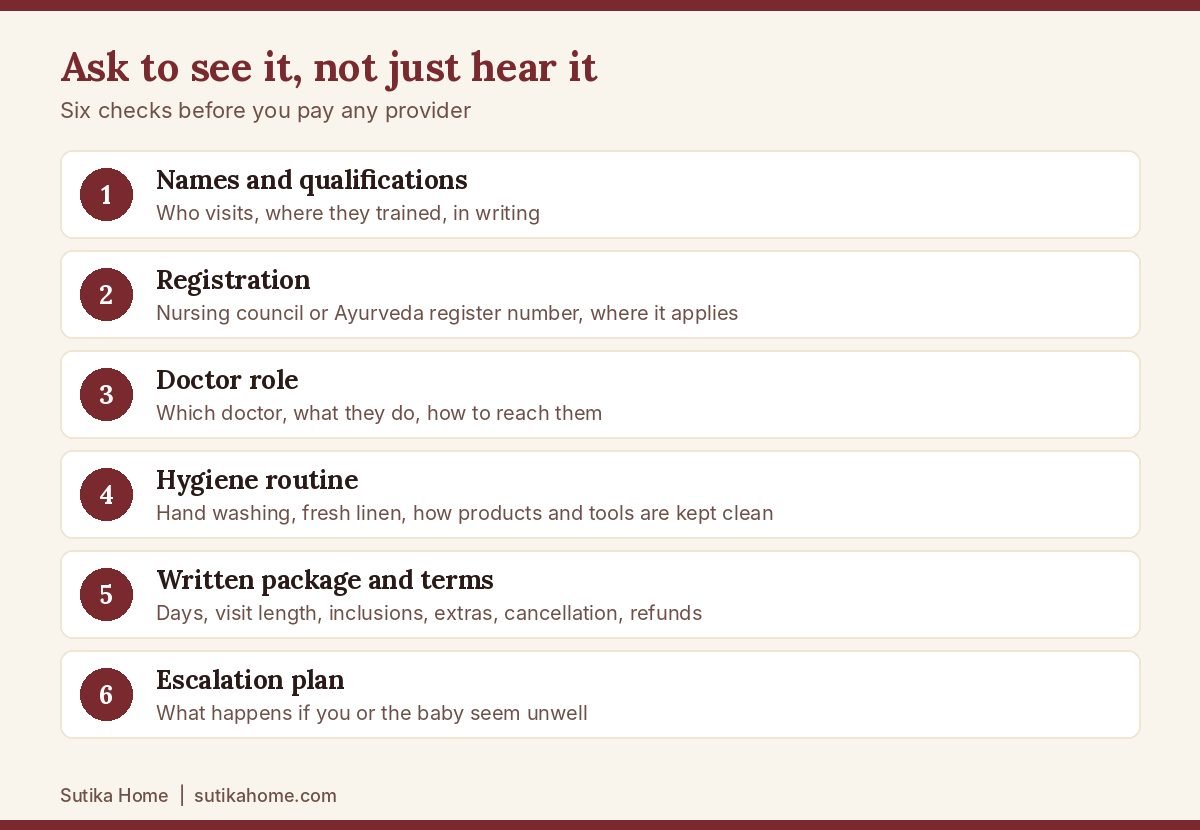
| Who visits | Named person, stated training, same person each day | “Someone will be sent” |
| Qualifications | Registration or certificate you can see and check | “Very experienced”, no paper |
| Doctor oversight | Named doctor, a clear role, a way to reach them | “Doctors are available” |
| Hygiene | Clean linen, hand hygiene, tools and products explained | Cannot describe a routine |
| What is included | Written list of visits, therapies and extras | “We will adjust as needed” |
| Contract and cancellation | Written terms, refund and replacement rules | Verbal promises only |
| Escalation | Clear steps if you or the baby seem unwell | No plan beyond “call us” |
| References | Can connect you with past clients, with consent | Only curated testimonials |
A total of 12 or more out of 16 suggests a provider that has thought about these things. Below that, ask more questions before you decide. The scorecard is a thinking aid, not a validated tool, so use it to start a conversation rather than to settle one.
A friendly voice on the phone can lift your impression of a provider that has not answered anything specific. Scores on a page make the gaps easier to see.
How to verify qualifications and doctor oversight
Anyone can say “trained” or “certified”. Turn those words into something you can check. Take them one at a time.
Qualifications and registration
Ask for the name of each person who will visit and the exact qualification they hold. Nurses should be registered with their state nursing council. The Indian Nursing Council keeps a list of state nursing councils. If a provider describes someone as an Ayurvedic doctor, ask for their registration number. Under the NCISM regulations, practitioners of Indian systems of medicine are expected to display their registration certificate and to show their registration number on prescriptions and receipts (NCISM Ethics and Registration Regulations, 2022).
Massage and postnatal therapy skills are different. There is no single universal licence for these, so ask where the therapist trained, for how long, and who checks her work. Honest providers will tell you plainly.
Doctor oversight
Doctor-guided can mean many things. Ask four questions. Which doctor? What is her or his qualification? What do they actually do: examine you, review a plan, or only sign a form? How can you reach them if something changes? A doctor who reviews your delivery details and sets limits for therapies is meaningful. A name on a brochure is not.
If you had a surgical birth, this matters more. Therapies and wound care are handled differently after a caesarean, and your own surgeon’s advice comes first. Our C-section recovery guide explains what usually changes.
Hygiene
You are letting someone into your home during a period of healing, with a newborn nearby. Ask simple, practical questions. Will the therapist wash her hands before touching you or the baby? Is linen fresh for each visit? Are oils, herbs and tools single-use or cleaned and stored properly? What happens if the therapist has a cold or fever? A good provider answers without getting defensive and will not mind if you refuse a product.
References
Curated testimonials on a website tell you little. Ask whether you can speak to one or two past clients, with their consent. Ask what went well, what did not, and how the provider handled the problem. Also ask a friend, your obstetrician or your paediatrician. They often know who is reliable.
Contract, cancellation and what is included
Most disputes in postnatal care come from unclear scope, not from bad intentions. A written summary solves most of them. Before paying, ask for the following in writing, by message or email if there is no formal contract.
- The number of days and the visit length, including start and end dates.
- Which therapies are included and which are paid extras.
- Which items you provide and which the therapist brings, such as oils, herbs, towels and binding cloth.
- What happens if the therapist is ill or leaves: is a replacement offered, and how quickly?
- The rules for cancelling, pausing or postponing, including a baby arriving early or late, or a C-section being planned.
- How and when payment is taken, and what is refunded if you stop early.
- What is done when you or the baby seem unwell during a visit.
Dates are the part families most often forget. Babies arrive when they choose, so ask how flexible the start date is and what the provider does if the delivery date moves. The same applies to length. If you are not sure whether to book 14 or 40 days, ask for a recommendation and the reason for it. Our guide on what postnatal care costs explains how package length and extras tend to shape a quote, without giving fixed numbers.
Compare like with like. A short visit and a long one, or a mother-only package and a mother-and-baby package, are different products. Write down hours per visit, days per week and the tasks included, then compare. If a provider cannot put its offer in a few lines, that is information too.
Red flags that should make you pause
One red flag does not mean you should walk away. Several together usually do. These are the patterns we would take seriously.
- Promises of cure or guaranteed results, such as “this will fix your belly” or “this prevents back pain for life”. Postnatal recovery is individual and no honest provider can guarantee an outcome.
- Therapy offered to everyone in the same way, whether you had a vaginal birth, a C-section or a complication.
- Reluctance to name staff, share qualifications or let you speak to the doctor.
- Pressure to pay in full today, or “limited slots” used to rush you.
- No written terms, or terms that change from one conversation to the next.
- Advice to ignore or delay your own doctor, or to stop prescribed medicines.
- Therapists who do not wash their hands, bring unlabelled products or use the same cloth between clients.
- No plan for what happens if you develop a fever, heavy bleeding or other warning signs.
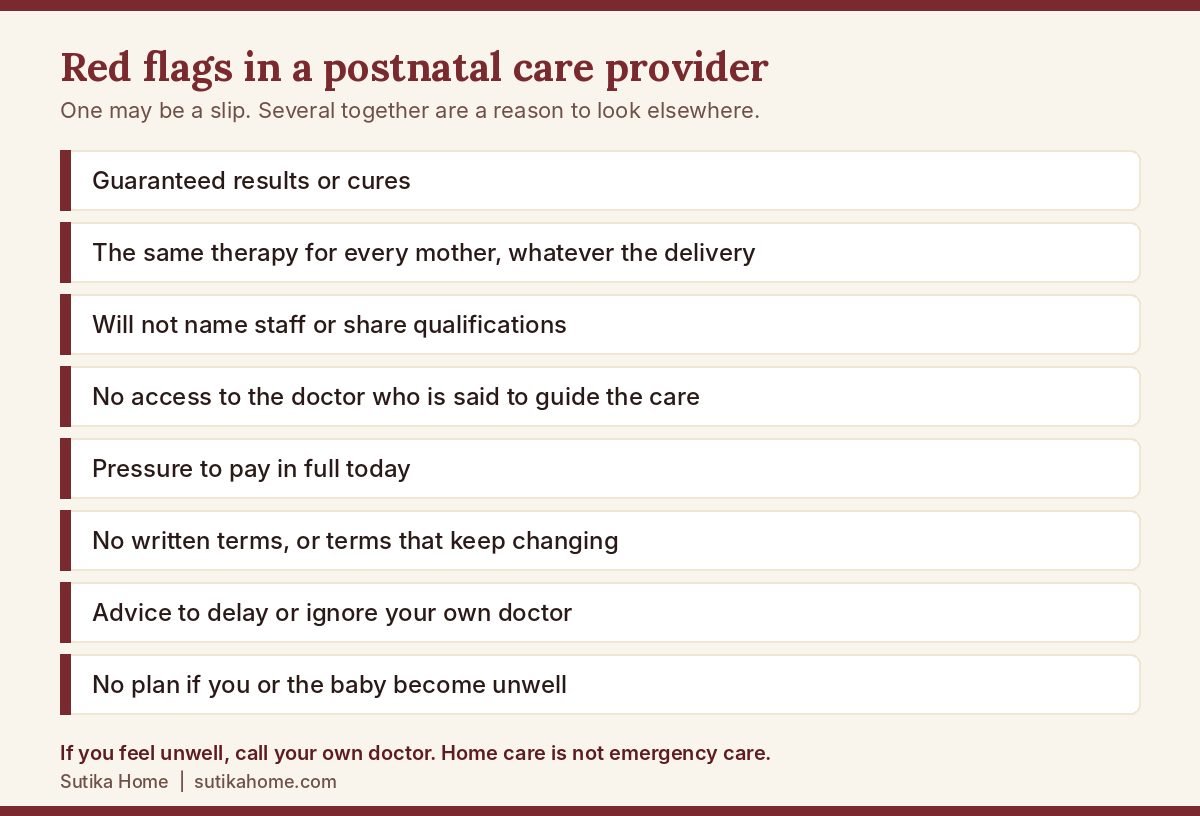
Care at home is not emergency care. Seek urgent medical help for heavy bleeding, fever, foul-smelling discharge, a red or leaking wound, severe or worsening pain, a painful swollen calf, chest pain or breathlessness, a severe headache or vision changes, or feelings of hopelessness or thoughts of harming yourself. Tell your doctor if low mood lasts beyond the first couple of weeks. A good provider will say the same on the first call.
Matching the type of provider to your situation
There is no single right answer. These pointers may help you narrow the field, but your own doctor knows your situation best.
- You want hands-on traditional therapies and a doctor involved: look at doctor-guided home services and Ayurvedic centres, and compare them using the scorecard above.
- Your main need is medical follow-up and lactation advice: a hospital programme may fit, as long as the follow-up reaches your home or fits your travel limits.
- You need help urgently, at short notice: an agency may be fastest, but verify who is coming before you agree.
- You already trust one therapist: an independent therapist can work well, provided you agree how a replacement works.
- You are mostly looking for someone to look after the baby and house: that is a different job. Our guide to postnatal care versus a nanny sets out who does what.
Many families combine two. For instance, a hospital for check-ups plus a home therapist for daily care, or a therapist for you plus a helper for the baby. Tell each provider what the other covers so no one is surprised. Our overview of postnatal care at home lists what a good home visit can include.
Where Sutika Home fits in
Sutika Home provides doctor-guided, Ayurveda-informed postnatal care at home. Our postnatal care service includes daily home visits for 7, 14, 28 or 40 days. Therapies include Abhyanga (oil massage), Vethukuli (herbal bath), Udara Veshtana (abdominal binding), Kesh Dhoopanam (hair fumigation), Anjana (eye care) and diet guidance. Care is adapted for normal delivery and C-section, and visits are tracked in an app. We are available Monday to Saturday, 9 am to 8 pm.
Ayurvedic practices are traditional. Traditional use is not proof that a therapy speeds healing, and we ask every mother to follow her own doctor’s advice first. We are also open about coverage: tell us your city and area, and we will confirm whether we can serve you. We would rather say no than overpromise.
Please use the same scorecard on us. Ask us the same questions you would ask anyone else.
Conclusion
The best provider is rarely the one with the best website. Look for the one that can tell you who is coming, who is in charge, how hygiene works, what is in the package and what to do if something goes wrong, and can show you proof. Score two or three options on the same sheet, speak to a past client if you can, and check registrations before paying.
If you would like to talk it through, you can use the contact page to request a call back. There is no pressure. Bring your list of questions and your due date, and we will explain how our care works.
Frequently Asked Questions
What should I check first when comparing postnatal care providers?
Start with who will actually visit you and what training they have. Then ask which doctor guides the plan and how to reach them. After that, check hygiene practices, the written list of what is included, and the cancellation terms. If the provider cannot answer these clearly, treat that as useful information.
Is a hospital postnatal programme better than care at home?
Neither is better for everyone. A hospital programme offers a medical setting and your delivery records in one place, while care at home saves travel and lets a therapist see your actual surroundings. Ask each option whether it includes home visits and what happens between appointments, and follow your own doctor’s advice.
How do I verify a therapist’s or doctor’s qualifications?
Ask for the name, qualification and registration number, then check them with the relevant council. Nurses register with their state nursing council, and Ayurvedic doctors with the state or national register for Indian systems of medicine. Massage and postnatal therapy have no single licence, so ask where the therapist trained and who supervises her work.
Can Ayurvedic postnatal care replace my obstetrician’s advice?
No. Ayurvedic care is a traditional practice and should sit alongside your obstetrician’s guidance, never replace it. Traditional use is not proof of benefit. Tell your provider about your delivery type, any complications and your medicines, and skip or adjust a therapy if your doctor advises it.
What should be in a postnatal care contract?
Ask for the start and end dates, visit length and days per week, the therapies included, items you must provide, and who replaces a therapist who is ill. Also ask for the payment schedule, cancellation and refund rules, and the plan if you or the baby become unwell. Written messages or email are fine if there is no formal contract.
What are the biggest red flags in a postnatal care provider?
Be careful with guaranteed results, the same therapy for every mother, refusal to name staff or let you speak to the doctor, pressure to pay in full today, no written terms, and advice to delay your own doctor. Poor hygiene and no plan for emergencies are also reasons to look elsewhere.
When should I get medical help instead of waiting for my therapist?
Seek urgent help for heavy bleeding, fever, foul-smelling discharge, a red or leaking wound, severe pain, a swollen painful calf, chest pain, breathlessness, a severe headache or vision changes, or thoughts of self-harm. Home therapy is not emergency care. Contact your doctor or go to a hospital without waiting for the next visit.
Sources
- WHO: quality care for women and newborns in the critical first weeks after childbirth (2022)
- WHO Recommendations on Postnatal Care of the Mother and Newborn (2013), NCBI Bookshelf
- National Commission for Indian System of Medicine: Ethics and Registration Regulations, 2022
- Indian Nursing Council: state nursing councils
Leave a Reply