In short: a postnatal herbal bath, known as Vethukuli in South Indian tradition, is a warm bath or pour-over wash with water boiled with leaves and herbs, usually given after an oil massage. Many mothers find it soothing. There is no good clinical evidence that it speeds healing, so treat it as comfort and tradition. Wait or skip it if you have a fever, a wound that is red or leaking, heavy bleeding, or your doctor has not cleared you. Keep the water comfortably warm, never hot.
A postnatal herbal bath is one of the oldest comfort rituals of the first weeks after delivery. If you are planning your recovery, you may be wondering what it involves, whether it is safe after a C-section or stitches, and how it fits into a day when a baby needs you every two hours. This guide explains Vethukuli in plain language, how families do it at home, who should wait or skip it, and how it sits inside a daily home-visit plan. It is general information, not medical advice. Your own doctor’s advice comes first.
What is Vethukuli, the traditional postnatal herbal bath?
Vethukuli (also spelt Vethu Kuli) is a warm herbal bath given to new mothers in South Indian, and especially Kerala and Tamil, postnatal care. The name roughly means a bath in hot, herb-infused water. It is part of what Ayurveda calls Sutika Paricharya, the traditional care of a mother after childbirth, which also includes rest, warm and easily digested food, oil massage and binding the abdomen, usually over about 40 days. You can read more about that period in our guide to the 40 days after delivery.
In most households the bath follows a warm oil massage. The oil is left on for a short while, and the warm herbal water is then poured over the body. Many families use a natural gram flour (besan or green gram) paste instead of soap. Afterwards the mother rests, often with the tummy bound. Sutika Home’s site describes it the same way: a warm herbal bath, traditionally given after the oil massage in South Indian postnatal care.
One point matters before anything else. Vethukuli is a tradition, not a medical treatment. It is meant to be gentle, warm and calming. It is not meant to treat any condition, and it should never replace a check-up.
What goes into the water
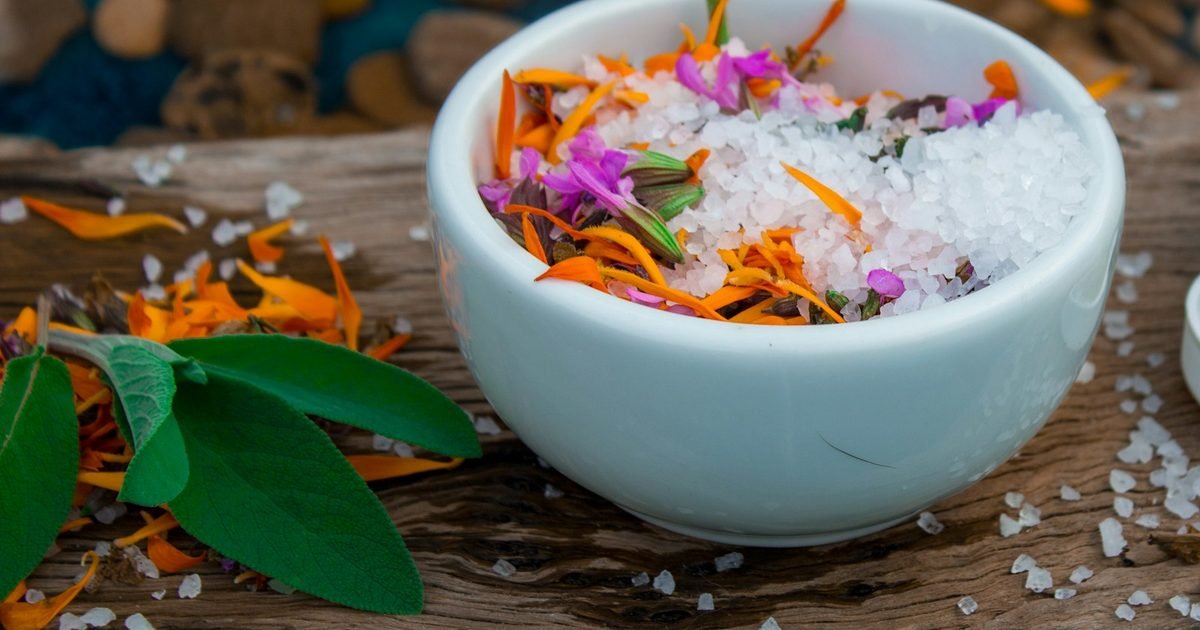
There is no single fixed recipe. Practitioners usually name a handful of leaves that are boiled in water, then strained. Commonly mentioned examples include guava, mango and jackfruit leaves, along with turmeric or turmeric leaf, and the mix changes from region to region and family to family. Ayurvedic texts describe these as “Vata-pacifying” herbs, which is traditional language rather than a measured effect.
A 2026 survey of medicinal baths for new mothers among the Hakka people in China found much the same pattern in another culture. People combined three to five plants, with “no fixed formula”, and the paper reports cultural importance, not clinical results. It did not test whether the baths work or whether they are safe. The same goes for herbal baths in most places: widely loved, rarely studied.
This is why a trained person should choose and prepare the herbs. Plant identity and strength vary, and some leaves can irritate skin. If you have a known allergy or very sensitive skin, tell your therapist or doctor beforehand and ask for a small patch test on your forearm.
What the evidence does and does not say
Warm water is comforting, and that part is easy to believe. The American College of Obstetricians and Gynecologists notes that sitting in warm, shallow water (a sitz bath) can ease swelling and pain in the perineum, the area between the vagina and anus. That is a statement about warm water, not about herbs.
Claims that an herbal bath “cleans the womb”, strengthens joints or boosts milk supply come mostly from provider websites and traditional texts, and we could not find reliable clinical studies behind them. So we do not repeat them. If a provider promises specific results, ask what they are based on. A good answer sounds like “many mothers find it relaxing”, not “it will fix your back pain”.
How a postnatal herbal bath is done at home
Households differ, but the steps below describe a typical, careful home routine. If a trained therapist visits, they will usually handle all of it.
- Prepare the herb water earlier. The herbs are washed, boiled in water and strained. Traditionally it is used the same day or the day before.
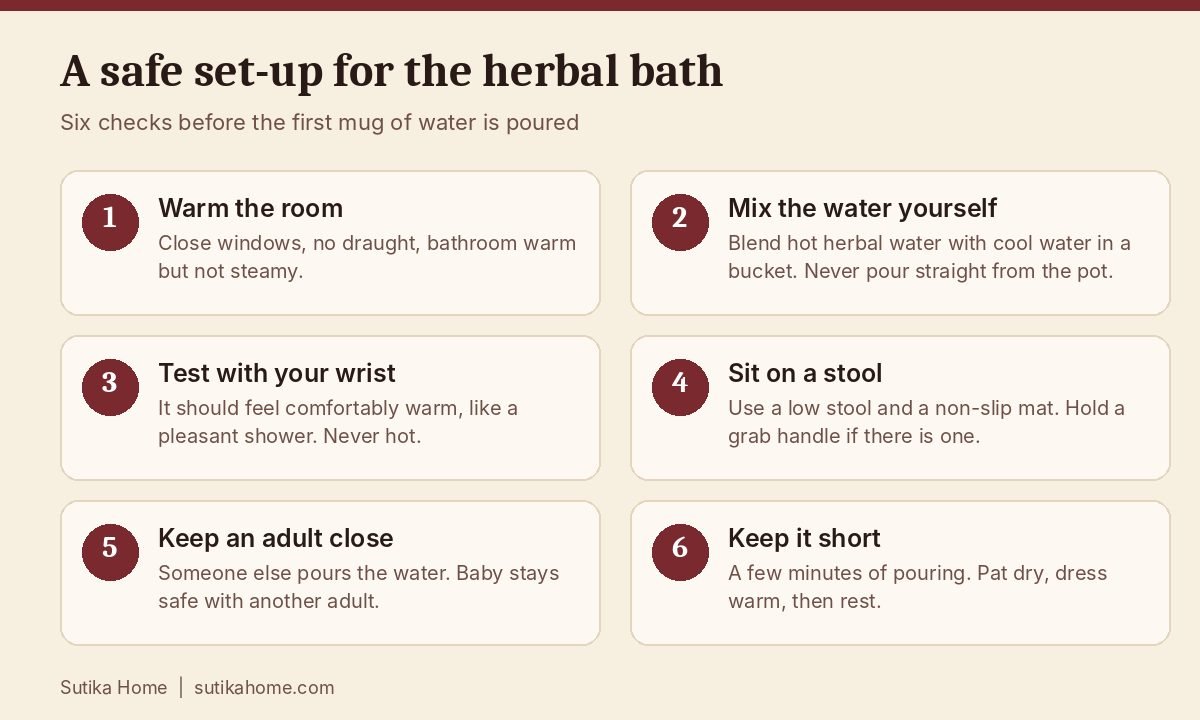
- Warm the bathroom. Close windows so there is no draught, and keep the room warm but not steamy. Lay a non-slip mat and put a low stool inside.
- Start with the oil massage. This is Abhyanga, usually 10 to 15 minutes, then a short wait. Our guide to postnatal massage and when to start covers timing and cautions.
- Check the water temperature. Mix the hot herbal water with cool water in a bucket until it is comfortably warm. Test it on your inner wrist and again on your forearm. Never pour water straight from the pot.
- Pour, do not soak. Sit on the stool. Someone else pours the water gently with a mug, working from the shoulders downwards. Many families avoid the head, or wash it separately.
- Wash lightly and dry gently. Use gram flour paste or a mild wash if your doctor is happy with it. Pat dry with a clean, soft towel. Keep the wound area dry if you have one.
- Dress warm and rest. Put on loose cotton clothes. Rest for a while, drink some warm water, and let someone else handle the baby.
The whole bath should be short and unhurried. If at any point you feel dizzy, breathless, faint or very tired, stop, sit or lie down, and call your doctor if it does not pass quickly.
Water temperature and bathroom safety
The biggest risks of a herbal bath at home are heat and slipping, not the herbs. New mothers are often tired, short of sleep and may have lost blood during delivery, so balance and alertness are not at their best.
Scalds happen faster than most people expect. A widely reproduced time and temperature chart, compiled by the US Consumer Product Safety Commission from 1940s studies, lists about 5 minutes of full immersion at 122°F (50°C) for a permanent burn, and about 1 minute for a first-degree burn. At 140°F (60°C) a permanent burn takes roughly 5 seconds. Those numbers describe full immersion and healthy adult skin, so treat them as a reminder that “hot” is not a safe test.
- Aim for comfortably warm, similar to a pleasant shower. If you need to ask “is this too hot?”, it is.
- Always mix the water yourself or have your therapist do it, and test with your wrist, not your fingertips.
- Keep the bath short. A few minutes of pouring is enough.
- Use a stool with a non-slip mat, a grab handle if available, and have another adult within earshot.
- Keep the baby in a safe place with another adult. Never carry hot water while holding the baby.
- Do not use the same herbal water for the baby unless your paediatrician has said it is fine. Newborn skin is far more delicate.
If water does scald the skin, cool the area under cool running water and get medical help for any blistering or a large area.
Who should wait or skip a postnatal herbal bath
Vethukuli is not for everyone, and not for every day. Here is when to wait for your doctor’s go-ahead, or skip it.
After a C-section
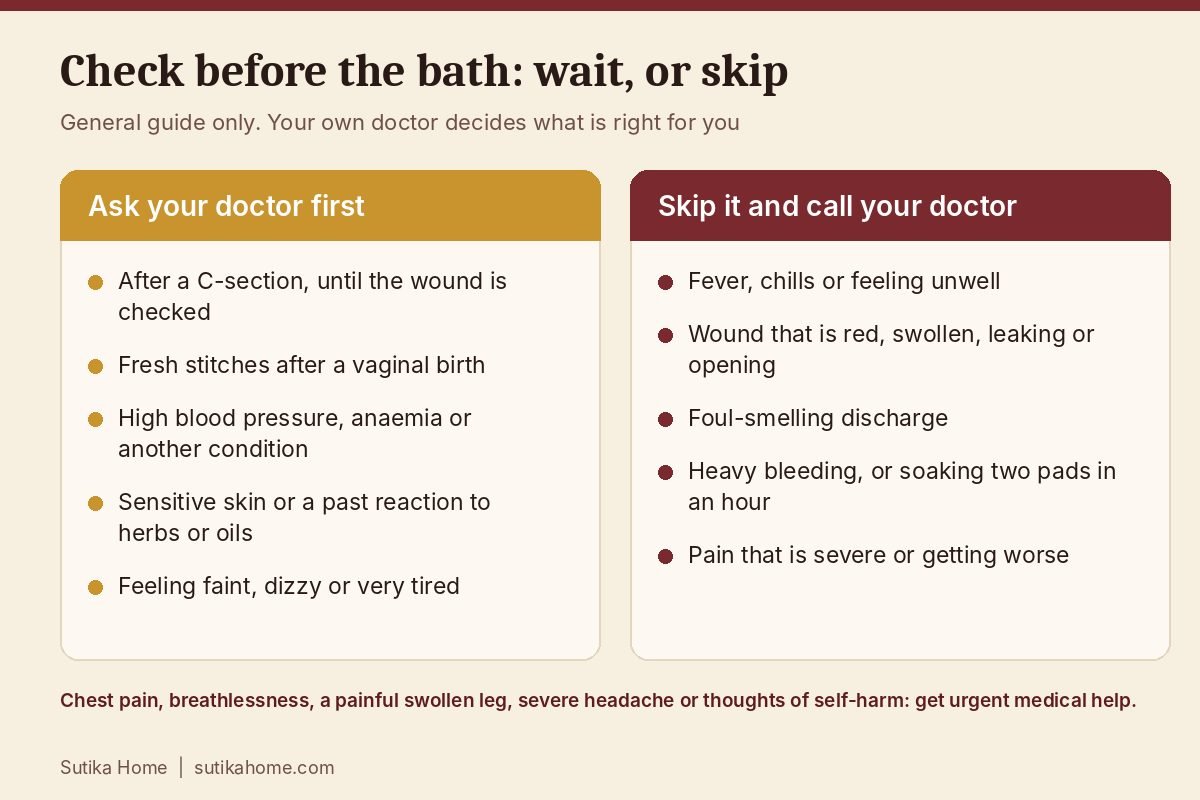
A C-section is major surgery, and the wound needs to stay clean and dry while it heals. NHS hospital leaflets say showering is preferable to bathing, and one (East Kent) advises avoiding baths until the wound has fully healed. If you only have a bath, it says to keep the water below the wound. Another trust says you can bathe as usual once the dressing is removed. Advice differs between hospitals, so ask your surgeon or obstetrician what applies to you, and do not rely on a fixed number of days from a website.
Some traditional sources suggest starting Vethukuli around 15 days after a C-section, once the wound has healed, and about 5 to 7 days after a vaginal birth. Those are traditional guides, not medical rules. A doctor needs to look at the wound and decide. Our C-section recovery guide explains what normal healing looks like.
Stitches after a vaginal birth
If you had a tear or an episiotomy, warm water can feel good. But adding herbs to water that touches fresh stitches is a question for your doctor, not something to try first. Skip the bath and call your doctor if the stitched area has more pain, redness, discharge or a bad smell.
Fever, infection or feeling unwell
Do not have a herbal bath if you have a fever or feel generally unwell. NHS wound leaflets list a temperature above 38°C, chills, redness, heat, swelling, pus and a bad smell as signs to call the maternity unit or your doctor straight away. ACOG gives fever above 100.4°F (38°C) as a reason to call. Those symptoms need a doctor, not a bath.
Heavy bleeding or other warning signs
Some bleeding (lochia) is normal after birth. ACOG lists soaking through two pads an hour for more than an hour or two, and foul-smelling vaginal discharge, as reasons to call your doctor. Passing large clots is another reason to call. Do not have a bath until you have been checked.
Other times to pause
- You feel faint, dizzy or breathless.
- You have a rash, itching or any skin reaction after a previous herbal bath or oil.
- Your doctor has flagged high blood pressure, anaemia or another condition and has not said a hot bath is fine.
- You are very exhausted. A day off is allowed.
When in doubt, skip the bath and ask. Missing one session costs you nothing. A wound infection costs far more.
When to get medical help straight away
Never delay care because of a bath. Contact your doctor or go to the nearest hospital straight away for heavy bleeding, fever, a red, swollen, leaking or opening wound, severe or worsening pain, a severe headache or changes in vision, chest pain or breathlessness, a painful swollen leg, or thoughts of harming yourself or your baby. Tell your doctor too if low mood or anxiety lingers or gets worse. The WHO publishes a guideline on postnatal care that explains why follow-up in the weeks after birth matters.
How Vethukuli fits into a daily home-visit plan
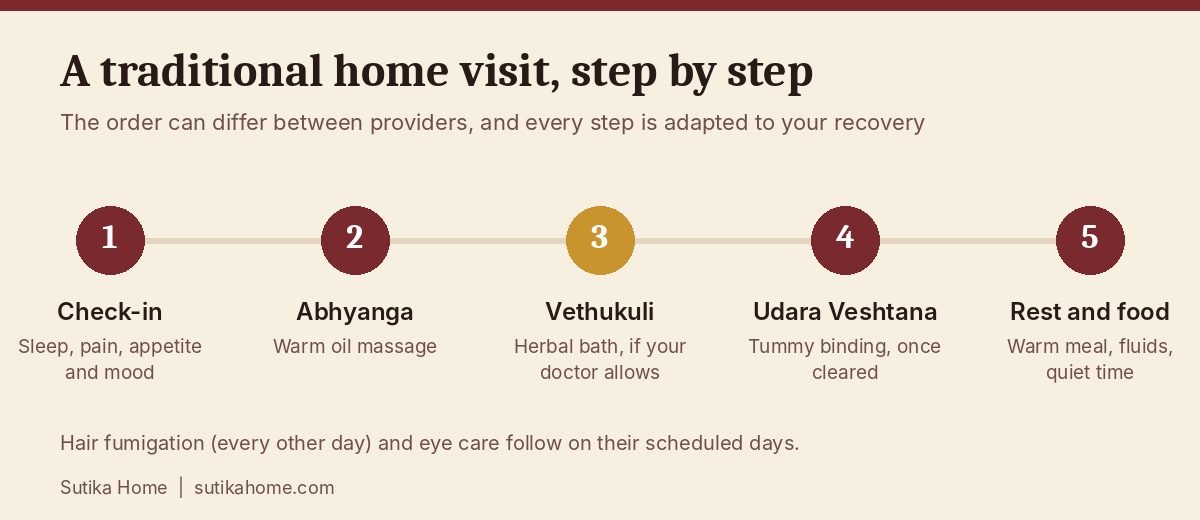
Vethukuli rarely stands alone. In a home-care plan it is one part of a routine that repeats most days. On Sutika Home’s plans, for example, a trained therapist visits every day and the plan includes Abhyanga, Vethukuli, Udara Veshtana (tummy binding), Kesh Dhoopanam (herbal hair fumigation, every other day), Anjana (traditional eye care) and diet guidance, all guided by a doctor. Plans run for 7, 14, 28 or 40 days.
A visit often runs roughly in the order below, though your provider may arrange it differently.
- A quick check-in: how you slept, your pain, appetite and mood, and anything worrying you or the therapist.
- Abhyanga, the warm oil massage, adapted to your delivery and healing.
- Vethukuli, the herbal bath, as the doctor allows.
- Udara Veshtana, tummy binding, which is only started when your doctor agrees. See our tummy belt guide for what to know.
- Rest, a warm meal and fluids. Hair fumigation and eye care follow on their scheduled days.
After a C-section, the plan changes. Massage and binding stay away from the wound and start only when the doctor is happy with healing. The herbal bath may begin later or take the form of a gentler wash. It all depends on your recovery, which is why a visit should begin with a check, not a routine.
Questions to ask before you book Vethukuli at home
- Who will give the bath, and what training do they have?
- Which doctor oversees the plan, and can I speak to them?
- When would you start after my delivery type, and what would make you delay?
- How do you check and control the water temperature?
- Which herbs do you use, and what if I react to one?
- What will you do if you notice a fever, a wound problem or heavy bleeding?
Good answers are specific. Be cautious about any provider who claims guaranteed results, or who says a doctor’s advice does not matter. For a wider look at what to ask, see our guide to postnatal care at home.
Is a herbal bath right for you?
A postnatal herbal bath can be a warm, quiet part of the first weeks with a newborn. Enjoy it as a ritual and a pause in a demanding day. Keep the water comfortably warm, protect your wound and stitches, and skip it whenever you have a fever, bleeding or a wound concern. Your doctor decides the timing.
If you would like to talk through how Vethukuli and the other traditional therapies could fit your recovery, you can request a call back from the Sutika Home team. Share your delivery date and area, and ask anything. There is no pressure to decide on the call.
Frequently Asked Questions
What is Vethukuli?
Vethukuli is a traditional South Indian postnatal herbal bath. Warm water boiled with leaves and herbs is poured over the mother, usually after an oil massage. It is part of a care tradition that also includes rest, warm food and abdominal binding. It is a comfort ritual, not a medical treatment, and it is not a substitute for your doctor’s follow-up.
When can I start a herbal bath after delivery?
There is no single correct day. Traditional guides mention about 5 to 7 days after a vaginal birth and around 15 days after a C-section, but these are not medical rules. Your doctor decides based on how you are healing, any stitches, and your bleeding. If you are unsure, wait until you have been checked.
Can I have a herbal bath after a C-section?
Only when your doctor says the wound is healing well. Hospital advice varies. Some say shower rather than bathe until the wound has healed, others allow baths once the dressing is off. Until then, a gentle shower is usually the safer choice. Never soak a wound that is red, leaking or opening.
What water temperature is safe for a postnatal herbal bath?
Comfortably warm, like a pleasant shower, never hot. Mix hot and cool water and test with your inner wrist. Scald charts show that water around 50°C can burn skin with several minutes of full immersion, and hotter water burns much faster. Keep the bath short, sit on a non-slip stool and have someone nearby.
Does a herbal bath help with milk supply or back pain?
We cannot say that. Some providers claim it does, but we found no reliable clinical studies to support these claims. Many mothers do find warm water relaxing, and rest and comfort are valuable in themselves. If milk supply or pain worries you, speak to your doctor or a lactation consultant.
Is it safe to use herbs on the skin after delivery?
Usually mild, but not guaranteed. Herbs differ, and some can irritate skin or trigger an allergy. Ask your therapist which herbs are used, request a patch test if you have sensitive skin, and stop at once if you get itching, rash or swelling. Tell your doctor about any reaction.
Can I give my newborn the same herbal bath?
Do not assume so. Newborn skin is much more delicate and a baby cannot tell you if water is too hot or a herb irritates. Ask your paediatrician before using any herbal water on a baby.
Sources
- Cambridge University Hospitals: Caesarean section wound care
- East Kent Hospitals: Reducing your risk of wound infection after a caesarean birth
- Guy’s and St Thomas’: Recovering after your caesarean birth
- ACOG: Postpartum pain management
- WHO: WHO recommendations on maternal and newborn care for a positive postnatal experience
- Traditional wisdom unveiled: medicinal bath plants for postpartum and infant healthcare among the Hakka people (BMC Complementary Medicine and Therapies, 2026)
- Burn rate time and temperature chart (US Consumer Product Safety Commission data, reproduced by A. O. Smith)
Leave a Reply