

In short: a postnatal care home visit usually runs in a set order. The therapist checks in with you first, then gives an oil massage, a warm herbal bath, abdominal care if it suits your recovery, and, on some days, hair fumigation and eye care. She also talks through food. A good visit adapts to how you feel that morning, and it stops whenever something looks wrong. This guide walks through the visit step by step so you know what to expect before the first knock on the door.
Most mothers worry about two things before day one. What will actually happen? And how much will they have to do? The second answer is easier: very little. You do not need to prepare a ritual. You need a warm room, a few household items and a rough idea of what is coming. The rest of this article covers both.
We describe the way our own therapists work at Sutika Home, because that is what we can speak about honestly. Other services run differently, so use this as a list of things to ask about, not a universal rule.
Before the therapist arrives
A good visit starts the evening before. You get a message confirming the time, and the therapist’s name if you asked for it. Security at many apartment communities in Indian cities needs advance notice, so share the details with your gate.
On the morning, feed and change the baby if you can, and ask someone to stay near the baby during the session. A family member, a helper or a partner is ideal. Your therapist is there for you, and a baby crying in the next room makes it hard to relax.
Set out a few things: a clean towel, a change of loose clothing, water to drink, and a bathroom that is safe underfoot. Hot water should be ready or easy to get. If you had a C-section, keep your discharge summary handy so you can show it.

Step 1: A short check-in
The first few minutes are a conversation. A therapist should ask how you slept, how your wound or stitches feel, whether you have fever or pain, how your bleeding is, and whether you are eating and passing urine normally. She should ask about your baby’s feeding too, since it affects how you sit and rest.
This is not a medical examination, and a therapist is not a replacement for your doctor. It is a way to decide whether today’s plan should go ahead as normal, be adjusted or be paused. If something worries her, she should tell you to call your doctor and, where the service has a supervising doctor, pass it on.
Be honest here. If you did not sleep, say so. If your back hurts or your breasts feel hard, say that too. Those details change what happens next.
Step 2: Abhyanga, the oil massage
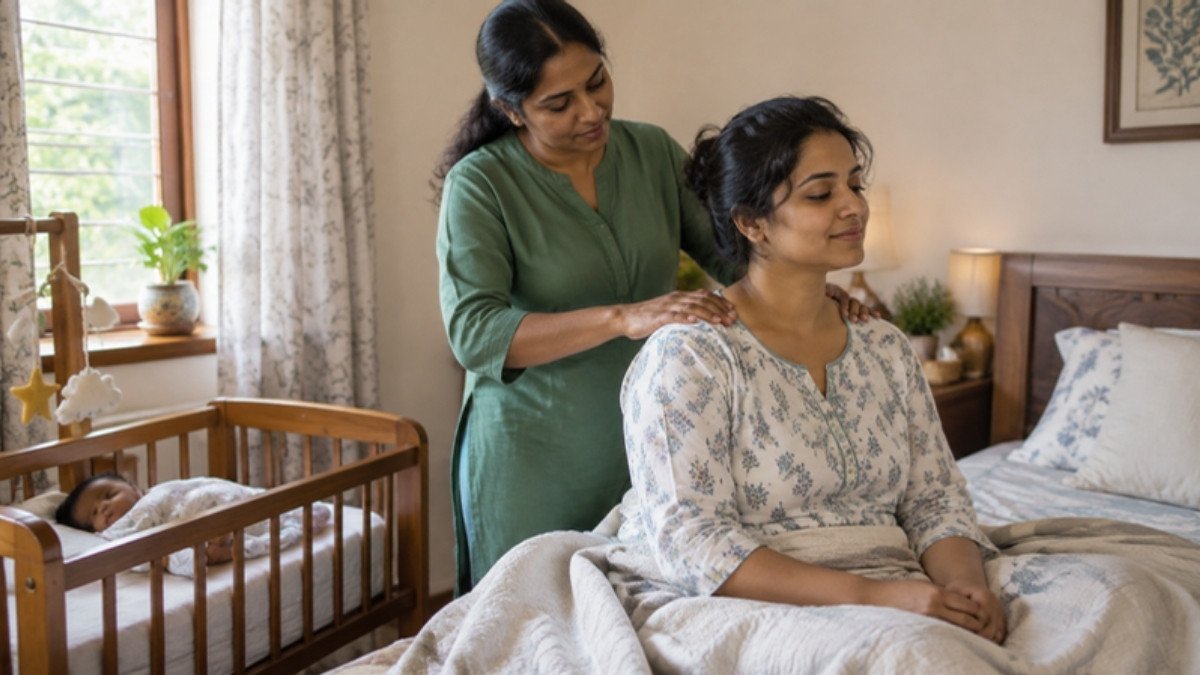
Abhyanga is a full-body massage with warm herbal oil, usually done with slow, rhythmic strokes. It is the part most mothers think of first. How firm the pressure is, and which areas are covered, depends on your delivery and recovery.
After a normal delivery with no complications, the massage is often started within days. After a C-section, the abdomen and the area around the wound are typically avoided until your surgeon says otherwise. Our guide to postnatal massage at home covers the safety checks in detail, and postnatal massage benefits and timing explains what the massage can and cannot do.
You may be asked to lie on your back, side and, if comfortable, front, supported by pillows. You can ask to stop or change position at any time. If you feel dizzy, hot or short of breath, say so immediately.
Step 3: Vethukuli, the herbal bath
After the massage comes a warm bath prepared with herbs. The water should be comfortably warm, never hot. The bathroom should be steamy but not stuffy, and someone should be within earshot.
This step is the one most often postponed. Reasons include a fresh C-section wound, stitches that are still healing, fever or any sign of infection, and heavy bleeding. Our guide to Vethukuli lists who should wait. A therapist who skips this step on a given day is doing her job, not letting you down.
Step 4: Udara Veshtana, abdominal binding
Udara Veshtana is traditional abdominal wrapping with a cloth after bathing. It is used only when it suits your recovery. After a C-section, binding over the wound needs your doctor’s agreement. If you have pain, a wound problem or a separation of the abdominal muscles, it may not be appropriate at all.
How tight is a fair question. It should feel supportive, never restrictive. You should be able to breathe fully, sit and feed the baby without pain. If it hurts, loosen it. Our guide to the tummy belt after delivery explains how a belt compares with traditional wrapping.
Step 5: Hair fumigation and eye care
On alternate days, Kesh Dhoopanam, a gentle herbal fumigation, warms and dries the hair after bathing. Anjana, a traditional eye-care step, is part of the classical routine. Neither is essential, and either can be skipped if you prefer. Tell the therapist if smoke bothers you or if you have asthma or sensitive eyes. Your comfort comes before the routine.
Step 6: Food and rest guidance
Before she leaves, the therapist should talk through food for the next day. For most mothers this means warm, light, easy-to-digest meals in the first week, and more variety as appetite returns. Our postpartum diet guide has a sample day and notes on what to limit.
Good guidance is specific to you. If you are anaemic, diabetic or recovering from a C-section, the advice should reflect that and should not clash with what your doctor said. Ask the therapist to explain the reasons. A tradition without a reason is harder to follow when you are tired.
Then rest. The point of the whole visit is that you can sleep afterwards. If the baby is asleep, lie down too.

What the visit does not include
It helps to know the limits. A postnatal care visit is not a doctor’s appointment, a lactation consultation or baby-sitting. A therapist will not diagnose, prescribe medicines or replace your follow-up. She will not usually cook, clean the house or look after the baby for you. If you want extra hands for the baby, read postnatal care therapist vs nanny to see how the roles differ.
If a service promises a lot more than this for a modest price, ask what is actually included and who does it.
How long does a visit take?
Ask your provider, because it varies with the plan and with how you are feeling. A visit that has to cover massage, a bath, binding and rest needs unhurried time, and a rushed one is a sign that the plan is too crowded. Let the therapist tell you the expected duration up front, and tell her if you need to cut the visit short for a feed.
How the visits change across the weeks
The first few days are usually the gentlest. Visits focus on warmth, rest and light massage as long as your doctor agrees. By the second week many mothers feel stronger, and the therapist may increase pressure or add steps. By weeks three and four, the focus often shifts towards getting you moving and eating well. In a 40-day plan, the later weeks are the quieter stretch, when family help may be thinning out but you are still healing.
Your plan should change as you do. If the routine feels identical on day 30 and day 3, ask why.
Signs a visit should be paused
Your therapist should stop, or you should ask her to stop, if you have fever, chills, heavy or increasing bleeding, severe pain, a red or leaking wound, a hot, swollen, painful calf, dizziness or breathlessness. Do not push through discomfort to keep to the schedule. Your plan can be rescheduled. Your health cannot.
Call your doctor or go to a hospital for heavy bleeding, fever, foul-smelling discharge, chest pain, a severe headache or vision changes, or thoughts of self-harm. Home therapy is not emergency care.
What to ask before you book
Ask who will visit, whether it will be the same person each day, what training she has, which doctor guides the plan, how hygiene is handled, what happens if she is ill, and how missed visits are handled. You can find a fuller list in our guide to comparing postnatal care services. Ask the same questions of every provider, including us.
Where Sutika Home fits in
At Sutika Home, a trained therapist visits daily for 7, 14, 28 or 40 days. Care is guided by a doctor and adapted for normal delivery or C-section. You can see your visits and message our team in the Sutika Home app. Learn more about our postnatal care at home service, or request a call back and tell us your area. We will confirm whether we can serve you.
Conclusion
A postnatal care home visit is simple once you know the order: a check-in, a massage, a bath, binding if suitable, a little extra care, then food guidance and rest. What matters is that each step is adjusted to you and can be skipped without fuss. Keep your own doctor informed, say when something feels off, and let the visit give you part of each day that is about your recovery.
Frequently Asked Questions
What happens during a postnatal care home visit?
The therapist usually starts with a short check-in about how you are feeling, then gives an oil massage and a herbal bath, followed by abdominal binding if suitable. On some days there is hair fumigation and eye care. She also talks through food and rest. Each step is adjusted to your delivery and recovery.
Do I need to prepare anything before the therapist arrives?
Keep a warm room, a clean towel, loose clothing, drinking water and hot water ready. Arrange for someone to watch the baby. Inform your apartment security if needed, and keep your discharge summary handy after a C-section.
Can I have a postnatal care visit after a C-section?
Many mothers do, but the plan is adapted. Massage near the wound and abdominal binding usually wait until your surgeon agrees. Ask your provider how they adjust care and follow your doctor’s advice first.
Is the herbal bath part of every visit?
Not necessarily. It may be postponed if you have a fresh wound, stitches that are still healing, fever, signs of infection or heavy bleeding. A good therapist will skip it on those days.
Does the therapist look after the baby?
The visit is focused on the mother’s recovery. Some providers offer optional baby massage or a baby bath. A therapist is not a nanny, and she will not usually cook or clean for you.
Can I stop a session if I feel unwell?
Yes. Tell the therapist right away if you feel dizzy, hot, short of breath or in pain. Call your doctor if symptoms continue.
How do I know if the therapist is trained?
Ask about her training and registration, whether a doctor supervises the plan and whether she is the same person each day. Provider guidance from bodies such as the National Commission for Indian System of Medicine and state nursing councils can help you check.
Sources
- WHO: quality care for women and newborns in the critical first weeks after childbirth (2022)
- WHO Recommendations on Postnatal Care of the Mother and Newborn (2013), NCBI Bookshelf
- National Commission for Indian System of Medicine: Ethics and Registration Regulations, 2022
- Indian Nursing Council: state nursing councils
Leave a Reply