

In short: diastasis recti is a gap between the two halves of your “six-pack” muscles, caused by pregnancy stretching the connective tissue between them. It is very common after delivery, and in many women it narrows over the first weeks and months. You can check it yourself by lying on your back and lifting your head slightly while feeling above and below the navel. A gap of two finger widths or more, doming or coning of the belly, or back pain that will not settle is worth showing a doctor or a women’s health physiotherapist. Avoid crunches, sit-ups and heavy lifting in the early weeks, and start with gentle breathing and deep core work instead.
Many mothers notice it a few weeks after delivery. The baby is out, but the belly still looks about five months pregnant, especially in the evening. Some women find a ridge or bulge running down the middle of the tummy when they sit up from bed. Friends say “it is just loose skin”, the internet says “do these ten exercises”, and nobody tells you which of those is true.
Below: what diastasis recti is, why it happens, how to check for it, which movements to avoid and which to try, and when to get professional help. It is general information, not medical advice, and your own doctor or physiotherapist can assess you properly.
What is diastasis recti?
The rectus abdominis, your “six-pack” muscle, is made of a left and a right half joined by a strip of connective tissue called the linea alba. During pregnancy this strip thins and stretches to make room for the growing womb. After birth it does not always spring back at once. When the gap is wider than about 2 cm, it is called diastasis recti, or “abdominal separation”.
According to the Cleveland Clinic, around six in ten women have it after childbirth, and one study found that about 45 per cent still had it at six months. It is more likely after twins, a larger baby, closely spaced pregnancies or a second or later baby, though first-time mothers get it too. It is not a tear and it is not dangerous by itself.
What it can do is affect how your core works. Some women notice a bulge, low back pain, poor posture, a weak feeling in the tummy or trouble lifting. Others have no symptoms at all and only find out when someone checks. If you also have leaking when you cough, or a heavy feeling in the pelvis, that points to the pelvic floor, and our guide to pelvic floor exercises after delivery is a good next read.
How to check for diastasis recti at home
A simple self-check works best a few weeks after delivery, once you feel comfortable lying on your back. If you had a C-section, wait until your doctor says the wound is healed enough for you to do this.
- Lie on your back with your knees bent and feet flat on the bed.
- Place your fingertips, pointing down towards your toes, just above your navel.
- Lift your head and shoulders very slightly, as if starting a small crunch, and press gently into the tummy.
- Feel for a soft gap between the two muscle edges. Count how many fingers fit. Repeat just below the navel and halfway between the navel and the breastbone.
A gap of about two finger widths or more is worth discussing with your doctor. Pay attention to how the tissue feels as well. If the gap feels firm and the line stays flat, your core is working well. If it feels soft and deep, or the tummy domes into a ridge as you lift, the core is not controlling pressure yet and needs attention.
A self-check is a guide, not a diagnosis. A doctor or a women’s health physiotherapist can feel the tissue properly, and may use an ultrasound or calipers to measure.

How long does diastasis recti take to heal?
There is no single answer. The Leeds Teaching Hospitals physiotherapy team says most separations improve within eight weeks of birth, and that if you can still fit more than two fingers between the muscles at the navel after eight weeks, with a visible bulge, you should speak to your doctor, who may refer you to physiotherapy. Many women see the gap narrow over the first six to eight weeks as tissues recover. For some it continues improving over several months, and some stay with a small gap for years without any problem. The Cleveland Clinic says the timeline depends on the size of the separation and how consistently you do appropriate strengthening, and that it is never too late to work on it. It can also return after a later pregnancy, so the exercises are worth learning.
A narrow gap that is not causing any trouble often needs nothing more than time, good posture and sensible movement. A wider gap with pain, a bulge or weak control usually does better with guided exercise.
Movements to avoid in the early weeks
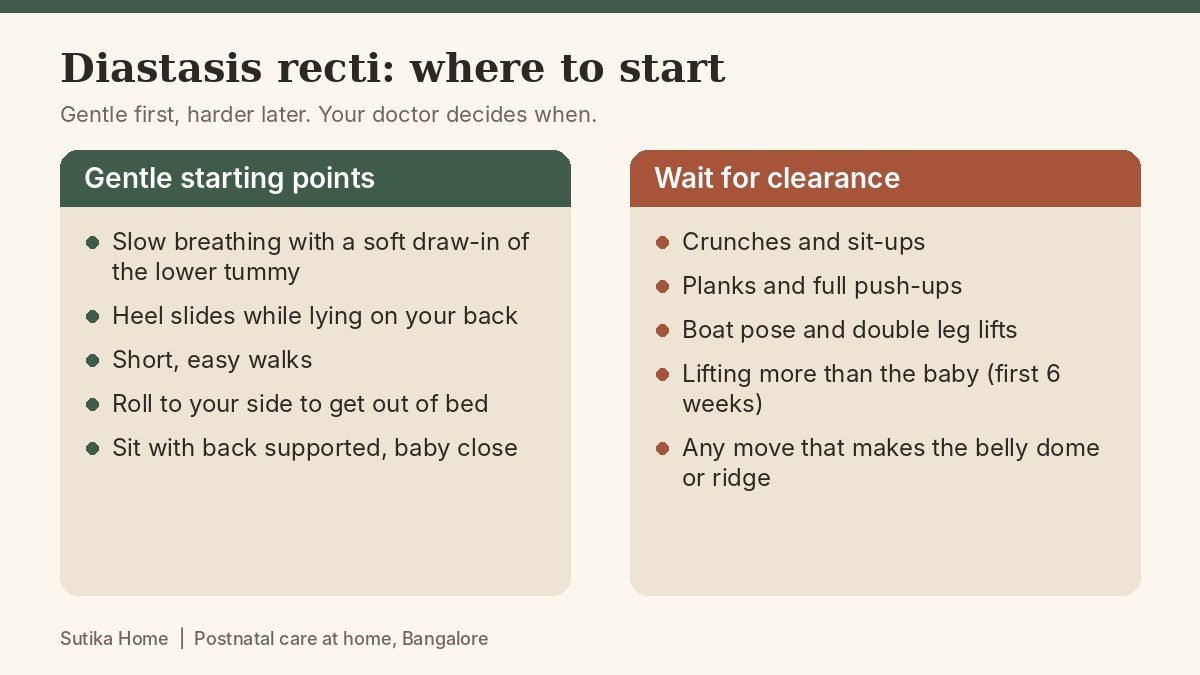
The aim is to avoid anything that makes the tummy dome or cone outwards along the midline, because that means the core is not holding the pressure. Until a professional says otherwise, avoid:
- Crunches, sit-ups and double leg lifts.
- Planks and full push-ups. A modified version on your knees may be fine later.
- Yoga poses such as boat pose, or any move that makes your belly bulge.
- Lifting anything heavier than your baby during the first six weeks.
- Sitting straight up from lying flat. Roll onto your side and push up with your arms instead.
The same applies to the pull of a bad cough, straining on the toilet and carrying heavy buckets or grocery bags. Support your tummy with your hand when you cough, and keep stools soft so you do not strain. Our guide to postpartum constipation has practical tips.
What helps: a gentle approach
Start with breathing
Lie on your back with your knees bent. Breathe in and let your ribs and belly expand gently. As you breathe out, draw your lower tummy softly towards your spine, as if zipping up a pair of snug trousers from the pelvis upwards. Do not hold your breath, and do not tuck your ribs. Ten slow breaths, a few times a day, is enough to begin with. This works the deep core muscle, the transversus abdominis, that acts like a natural corset.
Add gentle movement
Once the breathing feels easy, add small movements. Heel slides, where you slide one heel along the bed and bring it back, and gentle knee drops, keep the tummy flat while you move. Short walks help too. Progress only when the belly stays flat and nothing bulges.
Use good posture while feeding and carrying
Many mothers hold the baby on one hip or lean back when feeding, and that puts extra strain on the front of the tummy and the lower back. Sit with your back supported and feet flat, bring the baby to you, and carry your baby close, with your ribs stacked over your pelvis. If back pain troubles you, our guide on back pain after delivery covers causes and relief.
A word about belts and wraps
Many women are told to wear a tight belt to “close the gap”. A belly band can give support and comfort, and it can help you feel more stable while you move, but it does not heal the separation on its own, and a belt worn too tight or for too long can add pressure to the pelvic floor. Read our guide on the tummy belt after delivery before you decide. After a C-section, ask your surgeon before using any binder over the wound.

When to see a doctor or physiotherapist
Book an assessment if any of these apply:
- The gap is two finger widths or wider, or the belly domes when you lift your head.
- You still see a bulge at three or six months, or it is getting worse.
- You have persistent back pain, pelvic pain or pain in the tummy.
- You leak urine when you cough, laugh or lift.
- You notice a painful lump around the navel, especially one that changes size when you strain. This could be a hernia, and your doctor should check it.
Treatment usually starts with guided exercise. Surgery is generally considered only when physiotherapy has not helped or a hernia is present, as the Cleveland Clinic notes. A women’s health or pelvic floor physiotherapist is the right person to ask for, especially one who sees mothers after delivery.
How postnatal care at home can support recovery
In the first weeks the trick is to be careful without being afraid to move. A trained therapist visiting daily can help you get in and out of bed, positioning for feeding, and with gentle routines, while your doctor decides when you can do more. A therapist is not a physiotherapist, and we do not claim to treat diastasis recti. We do work with your doctor’s advice about what is safe.
At Sutika Home, postnatal care at home runs for 7, 14, 28 or 40 days after a normal delivery or a C-section. Tummy binding, Udara Veshtana, and massage are adapted to your delivery and begin only when your doctor is satisfied with healing. If you have a wide gap, a hernia or a wound, tell the coordinator on the first call so the plan is built around it. Our postnatal massage guide explains what to expect, and our postnatal care services guide helps you compare providers. You can also request a call back to ask about plans for your area in Bangalore.
Frequently Asked Questions
Is diastasis recti normal after pregnancy?
Yes. Some separation is expected as the muscles stretch to make room for the baby, and it is very common after delivery. It becomes a concern when the gap stays wide, causes pain or weakness, or comes with a hernia.
How do I know if I have diastasis recti?
Lie on your back with knees bent, lift your head slightly and feel along the midline with your fingers. A gap of two or more finger widths, or a ridge that domes upwards, suggests it. A doctor or physiotherapist can confirm it.
When can I start exercising after delivery?
Gentle breathing and walking are usually fine early on, but timing depends on your delivery and whether you have stitches or a C-section wound. Ask your doctor before starting any exercise programme, and wait for clearance after a C-section.
Can I get rid of the gap with crunches?
No, crunches and sit-ups can make the belly bulge and may widen the gap. Deep core exercises with controlled breathing are safer, and they work with the way the abdominal muscles support the spine.
Does a tummy belt fix diastasis recti?
A belt can support and comfort you, but it does not heal the separation. Use it as advised by your doctor, not as a substitute for exercise.
Will diastasis recti go away on its own?
It narrows in many women over weeks to months, and a mild gap may need nothing more. A wider gap or one with symptoms usually needs a guided programme. It can come back in later pregnancies.
Does a C-section cause diastasis recti?
Pregnancy causes it, not the type of delivery, so a gap can be present after a C-section too. After surgery you should wait for your doctor’s clearance before doing any exercise or self-check on the belly.
Will I need surgery for diastasis recti?
Rarely. Surgery is generally considered only if physiotherapy has not helped, or if there is a hernia. Most women improve with exercise and time.
Leave a Reply