

In short: in the engorgement vs mastitis question, engorgement is the fullness, heaviness and tenderness in both breasts when your milk comes in, usually around days 3 to 5 after birth. Mastitis is an inflamed, painful, often one-sided area of the breast, and it can bring fever and flu-like aches. Engorgement eases with frequent, comfortable feeds, cold packs and gentle care. Mastitis that does not improve within 12 to 24 hours of home care, or that comes with a high fever, needs a doctor. Keep feeding unless your doctor tells you otherwise.
A few days after delivery, many mothers wake up to breasts that feel like stones. They are hot, tight and sore, and the baby cannot latch because the nipple has flattened out. Then someone in the family says “that might be mastitis” and the worry begins. Is this normal? Should the baby stop feeding? Do you need antibiotics?
The two conditions overlap, and that is why they are so often confused. Here is how engorgement and mastitis differ, what you can safely try at home, when the symptoms mean you should call your doctor, and how a trained postnatal helper can fit into this stage. It is general information, not a diagnosis, and your own doctor decides what is right for you.
What is breast engorgement?
Engorgement happens when your milk “comes in”. Your body sends extra blood and lymph fluid to the breasts, and milk production ramps up. The Cleveland Clinic notes that it usually starts about 3 to 5 days after birth, often peaks around day 5, and settles by about two weeks. It can start a little later, even on day 9 or 10.
Typically both breasts are swollen, especially towards the lower part. They feel firm, heavy and tender, and the skin can look shiny. Some mothers feel warm or a bit feverish. It is uncomfortable, but it is a sign that your milk supply is establishing, not a sign that something has gone wrong.
Engorgement is more likely when milk is made faster than it is removed. That happens if feeds are delayed, if the baby is sleepy and feeds less often, if the latch is shallow, or if you pump a lot. The late-night gap when everyone finally sleeps can set it off.
What is mastitis?
Mastitis is inflammation of the breast tissue. The NHS describes a breast that becomes swollen, hot and painful, often in one breast, with symptoms that can start quickly. You may notice a wedge-shaped hard area or lump, burning pain that is constant or only during feeds, and redness. On brown or black skin, redness can be harder to see, so rely on heat, swelling and pain as well.
Many mothers also feel unwell, with aches, chills, a temperature and tiredness, much like flu. In breastfeeding mothers, the most common cause is milk building up in part of the breast. The NHS says mastitis does not always need medical treatment, but it can lead to infection and sometimes needs antibiotics.
A blocked duct is part of the same picture. It feels like a small, tender lump that may soften after a feed. If it is not cleared, it can become inflamed and turn into mastitis. So the three conditions sit on a spectrum, and you may move along it within a day or two.
Engorgement vs mastitis: how to tell the difference
There is no perfect home test, but a few clues help. These are rough guides, not a diagnosis.
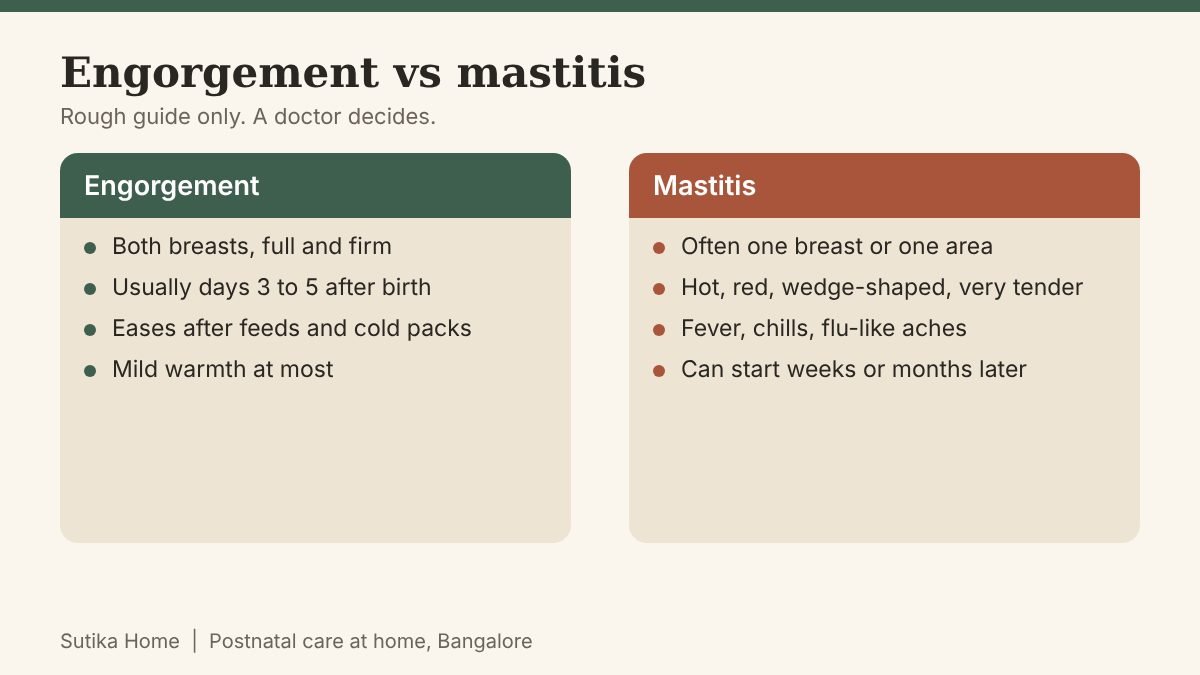
- Which breasts: engorgement usually affects both breasts. Mastitis more often affects one breast, or one area of it.
- When it starts: engorgement is typical in the first week or two, when the milk comes in. Mastitis can show up any time while you are feeding, including weeks or months later.
- How the breast feels: engorgement feels full and firm all over. Mastitis often has one hot, red, wedge-shaped, very tender patch.
- How you feel overall: mild warmth can come with engorgement. A clear fever, shivering and flu-like aches point more towards mastitis.
- What helps: engorgement often eases after a good feed and a cold pack. Mastitis tends to stay sore and may get worse.
The Cleveland Clinic adds one important point. If only one breast is affected and the problem does not clear with treatment, you need prompt evaluation by a doctor, because other conditions must be ruled out. That is a reason not to wait it out for days.
What to do at home for engorgement
Most engorgement settles with simple steps. The goal is to keep milk moving without pushing your breasts to produce even more.
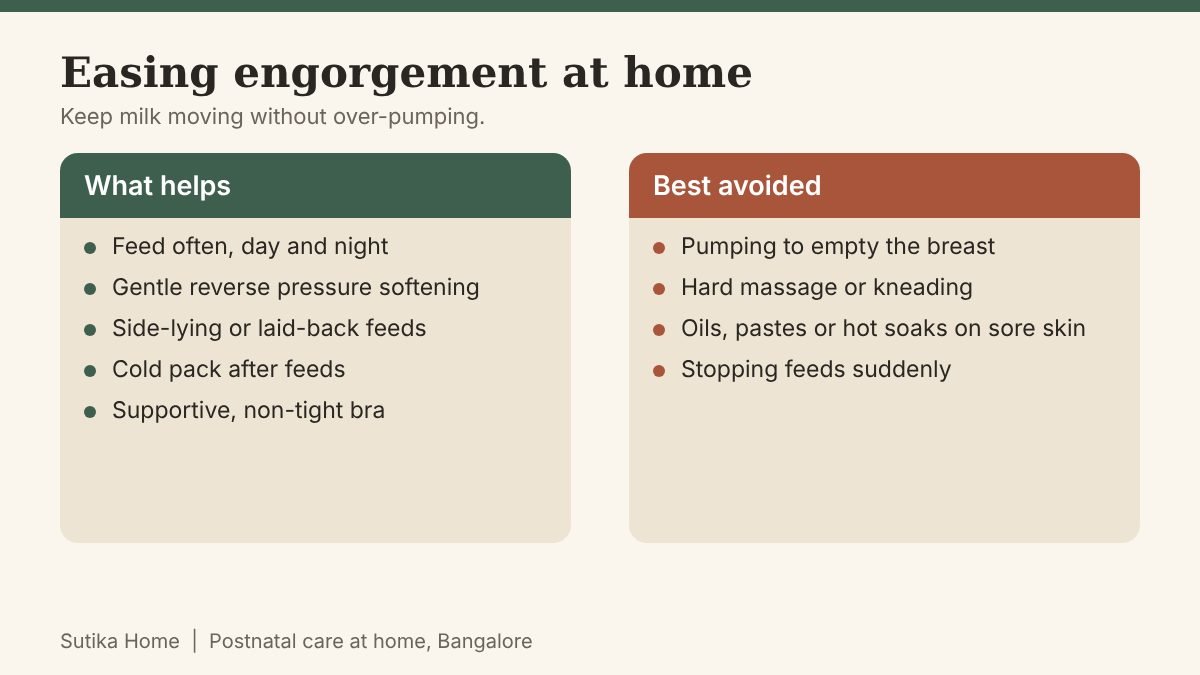
- Feed on demand, often. Offer the breast whenever the baby shows hunger cues, including at night, so the milk does not sit.
- Soften before you latch. If the areola is tight and the baby slides off, try gentle reverse pressure softening. Press steadily with your fingertips around the base of the nipple for one to three minutes, as a lactation nurse or your doctor can show you. This moves fluid back and makes the nipple easier to grasp.
- Try side-lying feeds or a laid-back position, which many mothers find easier when the breast is heavy.
- Use cold packs after feeds. A cloth-wrapped cold pack eases swelling and pain. Warm compresses just before a feed can help milk flow for some mothers, but cold afterwards is what usually brings comfort.
- Do not over-pump. Pumping to empty the breast tells your body to make more. Express only a little to relieve pressure if the baby cannot feed.
- Avoid vigorous massage. Hard kneading can bruise swollen tissue. Gentle strokes towards the armpit, if your provider recommends them, are enough.
- Wear a comfortable, supportive bra that is not tight. A well fitting bra does not cause mastitis, but a tight one can be painful.
- Ask your doctor about pain relief. Paracetamol or ibuprofen are often advised, but check what suits you, especially after a C-section.
If you are away from your baby, for example because the baby is in a neonatal unit, ask the nursing team how often to express. Your doctor or a lactation consultant can give a plan that fits your situation.
What to do at home for mastitis
The NHS advice for early mastitis is similar, with a few differences. Keep breastfeeding when your baby wants, because moving the milk helps. If it hurts too much, hand express just enough to feed your baby or to relieve the pressure. Do not express more than your baby needs.
- Check the latch. A poor position or attachment is a common cause, especially if mastitis keeps coming back. A midwife, doctor or lactation consultant can watch a feed and help.
- Apply a cold compress for about 10 minutes every hour for the first day. Use paracetamol or ibuprofen if your doctor agrees.
- Rest and drink fluids. Mastitis often hits when you are already worn out, so rest is part of the treatment.
- Avoid tight clothing, firm pressure or deep massage on the sore area, and do not stop feeding suddenly.
The NHS says to see a doctor if symptoms are not improving 12 to 24 hours after you start home care. A doctor may prescribe antibiotics. A very small amount of the medicine may reach the milk, but the NHS says this poses no risk to the baby, although the baby might be a little unsettled. If symptoms have not improved 48 hours after starting antibiotics, go back.
Do not stop feeding on your own because you think the infection will “spoil” the milk. Unless your doctor says otherwise for a specific reason, continuing to feed generally helps recovery. If you are unsure, ask before you stop.
When to call a doctor
Call your doctor the same day, or seek urgent care, in these situations.
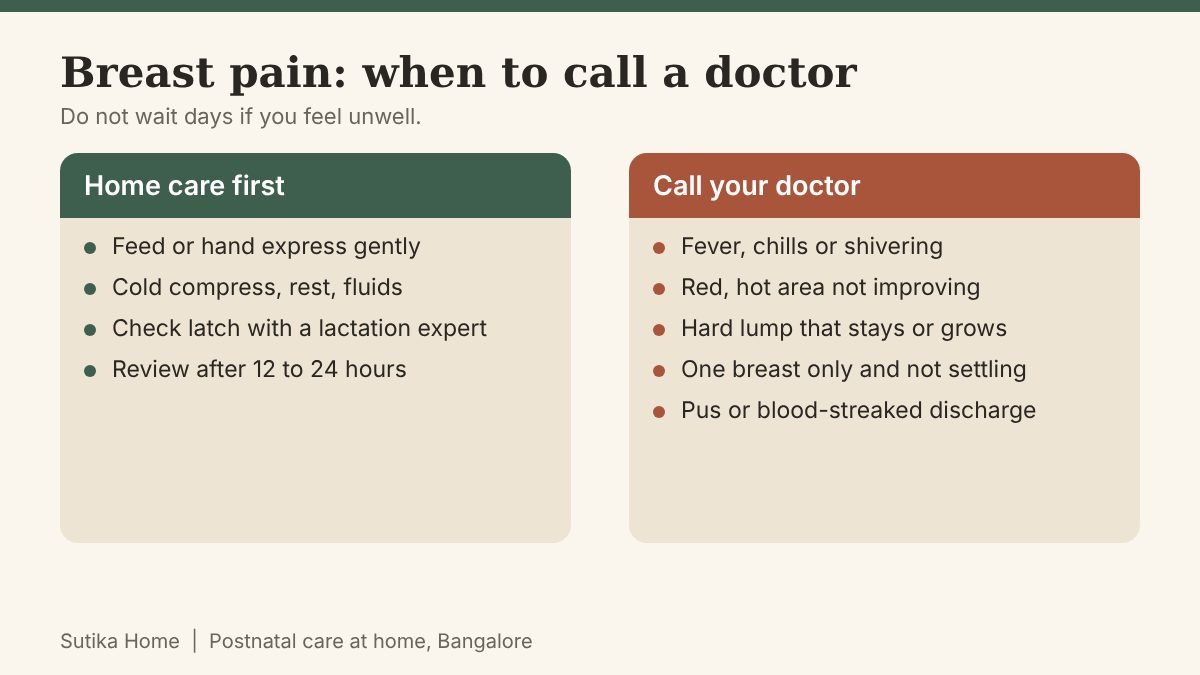
- A fever with chills or shivering, or you feel very unwell.
- A red, hot, painful area of the breast that is not improving 12 to 24 hours after home care.
- A hard lump that does not soften after feeds, or a lump with redness and increasing pain.
- Pus or blood-streaked discharge from the nipple, or a cracked nipple with spreading redness.
- Only one breast is affected and it does not clear, which needs prompt checking.
- Rapid heartbeat, feeling faint, or confusion. This needs urgent care.
- Symptoms that return again and again, which may point to a feeding or latch problem worth fixing.
If you are not breastfeeding and develop a hot, painful breast, see a doctor, since the causes are different.
How to prevent engorgement and mastitis
You cannot prevent every episode, but a few habits lower the odds.
- Start feeding soon after birth and feed often in the first weeks, without long gaps.
- Get help with the latch early. A shallow latch leaves milk behind and can damage the nipple, which is a way for bacteria to enter.
- Change positions between feeds so different areas of the breast get drained.
- Do not skip night feeds suddenly. When a baby starts sleeping longer, a short expression or a gradual change may help your body adjust.
- Wean slowly, over days or weeks, rather than overnight.
- Rest, eat regularly and drink to thirst. Exhaustion makes everything harder.
Our guide to breastfeeding support at home after delivery covers latch, positions and when to call for help in more detail. If tiredness is running your day, the article on postpartum sleep has realistic ideas for protecting your rest.
Traditional care, warmth and what to ask first
In many Indian families, warm compresses, oil massage and herbal poultices are used for sore breasts after delivery. Some of this is comforting, and some of it can make an inflamed breast worse. Hard massage, strong heat on a red hot area, or applying oils and pastes to broken skin are examples to avoid until a doctor has checked you. The NHS specifically advises against pressure, oils, soaks and creams on the breast when mastitis is suspected.
If you plan to have postnatal massage or Ayurvedic therapies at home, tell your therapist and doctor about any breast pain, lumps or fever before the session. Breast tissue is normally left alone during body massage, and a hot, red patch should be assessed first. You can read what a visit typically involves in our postnatal care home visit guide and how massage is adapted in the piece on postnatal massage at home.

How postnatal care at home can help
Engorgement peaks at a time when most mothers are still in the first week at home, short of sleep and unsure about feeding. Having a trained person visit daily means you have someone to notice early that a feed went badly, that you are skipping meals, or that the pain is changing. They cannot diagnose or treat mastitis, and they should send you to your doctor when warning signs appear. What they can do is help you rest, eat, and follow your doctor’s plan.
At Sutika Home, postnatal care at home includes daily visits from a trained therapist, with care guided by a doctor and adapted to your delivery and recovery. If you have a concern about breast pain or feeding, we encourage you to speak with your own doctor or a lactation consultant first. When you are ready to plan your recovery, contact our team and tell us your delivery date and area. You can also read how to compare options in our guide to postnatal care services.
Frequently Asked Questions
Is engorgement the same as mastitis?
No. Engorgement is fullness from milk coming in, usually in both breasts in the first week or two. Mastitis is inflammation of the breast tissue, often in one breast, and it can bring fever and flu-like aches. One can lead to the other if milk stays in the breast.
How long does engorgement last?
It usually begins about 3 to 5 days after birth and eases within about two weeks, with regular feeding. If it is not improving, or you have fever or a hard, red area, speak to your doctor.
Can I keep breastfeeding with mastitis?
In most cases, yes. Feeding moves the milk and helps recovery. If it is too painful, hand express enough to relieve pressure. Check with your doctor if you are unsure, especially if you are on antibiotics.
Do I always need antibiotics for mastitis?
Not always. The NHS says mastitis does not usually need medical treatment in its early stage. A doctor will often prescribe antibiotics if symptoms are not improving after 12 to 24 hours of home care or if you are unwell.
Should I massage a blocked duct hard to clear it?
No. Vigorous massage can bruise swollen tissue and make inflammation worse. Frequent feeds, a good latch, cold packs after feeds and gentle care are safer. Ask your doctor or a lactation consultant to show you what to do.
Can a tight bra or sleeping position cause mastitis?
The Cleveland Clinic says a supportive bra does not cause mastitis, though a very tight bra or firm pressure can be uncomfortable and is best avoided. Mastitis is mainly linked to milk building up and, sometimes, nipple damage.
When is a breast lump after delivery a worry?
A tender lump that softens after feeds is usually a blocked duct. See a doctor if a lump stays hard, grows, comes with redness, fever or nipple discharge, or if only one breast is affected and it does not settle.
Leave a Reply