
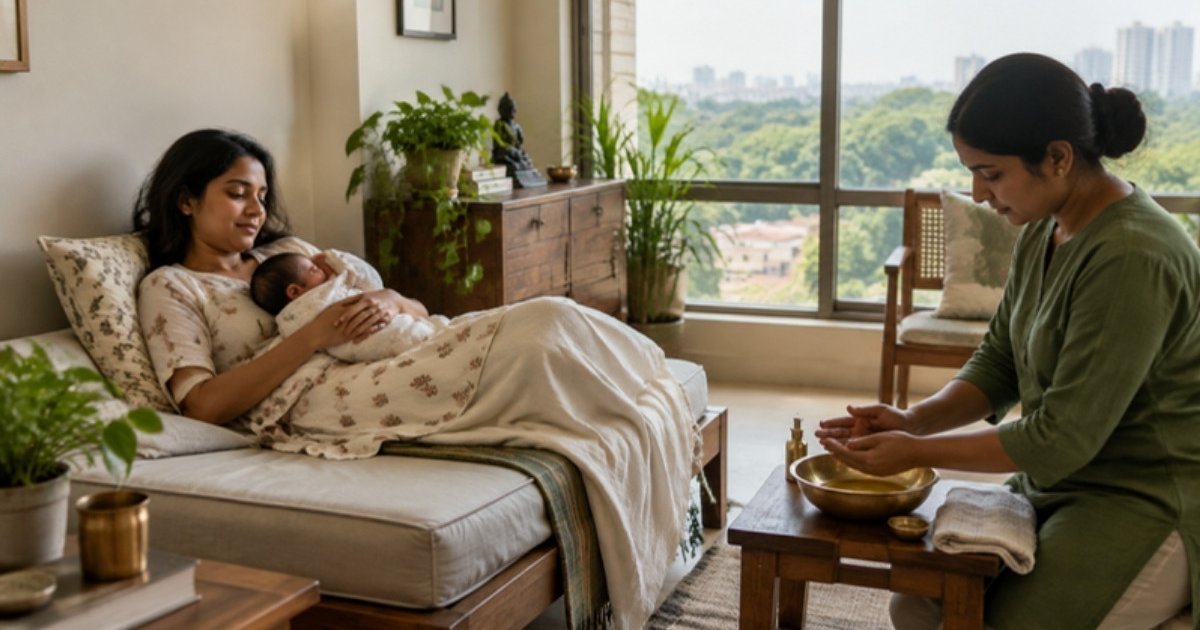
In short: postnatal care in Bangalore at home means a trained person visits you after delivery, usually daily, for massage, a herbal bath, abdominal care and diet guidance, while your own doctor stays in charge of your medical follow-up. The city adds a few practical questions that a generic guide skips: whether the provider covers your area, how they get past your apartment gate, what the visit time looks like in Bangalore traffic, and whether the plan survives a rainy week. This guide walks through those, plus the checks that matter anywhere.
If you are reading this in your third trimester or the first week after birth, you probably want a shortlist, not an essay. So here is the shortest honest version. Decide how many days you need, ask three or four providers the same questions, check who actually visits, and confirm the doctor’s role in writing. The rest of this article explains how to do each step without spending energy you do not have.
What postnatal care in Bangalore usually means
Search for postnatal care in Bangalore and you will find hospital programmes, home nursing agencies, independent masseuses, Ayurvedic centres and doctor-guided home services. They overlap in language and differ in practice. One offers a daily oil massage. Another sends a nurse to check your wound and weigh your baby. A third supplies a live-in helper who cooks and cleans.
Most families end up wanting a mix: some physical care for the mother, some food guidance, and the reassurance that someone qualified is watching how she heals. That mix is what the traditional first 40 days used to provide in a joint family. In a city where many couples live apart from their parents, a home service tries to fill that gap. Our guide to postnatal care at home covers the general idea. This article is about applying it in Bangalore.
One point is easy to miss. Postnatal care at home supports your recovery. It does not replace your obstetrician or paediatrician. The World Health Organization advises at least three further postnatal checks in the first six weeks, at 48 to 72 hours, at 7 to 14 days and at six weeks, with home visits where feasible (WHO, 2022). A good provider schedules around those visits and tells you to keep them.
What a typical home care plan includes
Plans differ, so ask for the list in writing. For reference, a doctor-guided Ayurvedic plan like ours includes a daily visit and these therapies, adapted to your delivery and your doctor’s advice:
- Abhyanga, a warm herbal oil massage. See our guide to postnatal massage at home for what a session involves and when to wait.
- Vethukuli, a herbal bath after the massage. Our page on the postnatal herbal bath explains who should postpone it.
- Udara Veshtana, traditional abdominal binding, used only when it suits your recovery.
- Kesh Dhoopanam, herbal hair fumigation, usually every other day.
- Anjana, a traditional eye-care step.
- Diet guidance suited to your delivery and to breastfeeding.
Other providers will list different things. That is fine. What you want is a written scope, so that “postnatal care” on the phone and “postnatal care” at your door mean the same thing.
Questions that matter more in Bangalore
Some questions apply in any city. A few are sharper here.
Do you serve my area?
Bangalore is large, and a provider whose team lives in Whitefield may not realistically reach Jayanagar every morning. Give your locality and pin code on the first call and ask for a clear yes or no. We would rather tell a family we cannot reach them than promise and cancel later.
What time will the visit be, and how fixed is it?
Morning and evening traffic can move a visit by an hour or more. If your baby sleeps best at a certain time, or you want the massage before a feed, say so on day one. Ask what happens if the therapist is delayed and how you will be told.
How does the therapist enter the building?
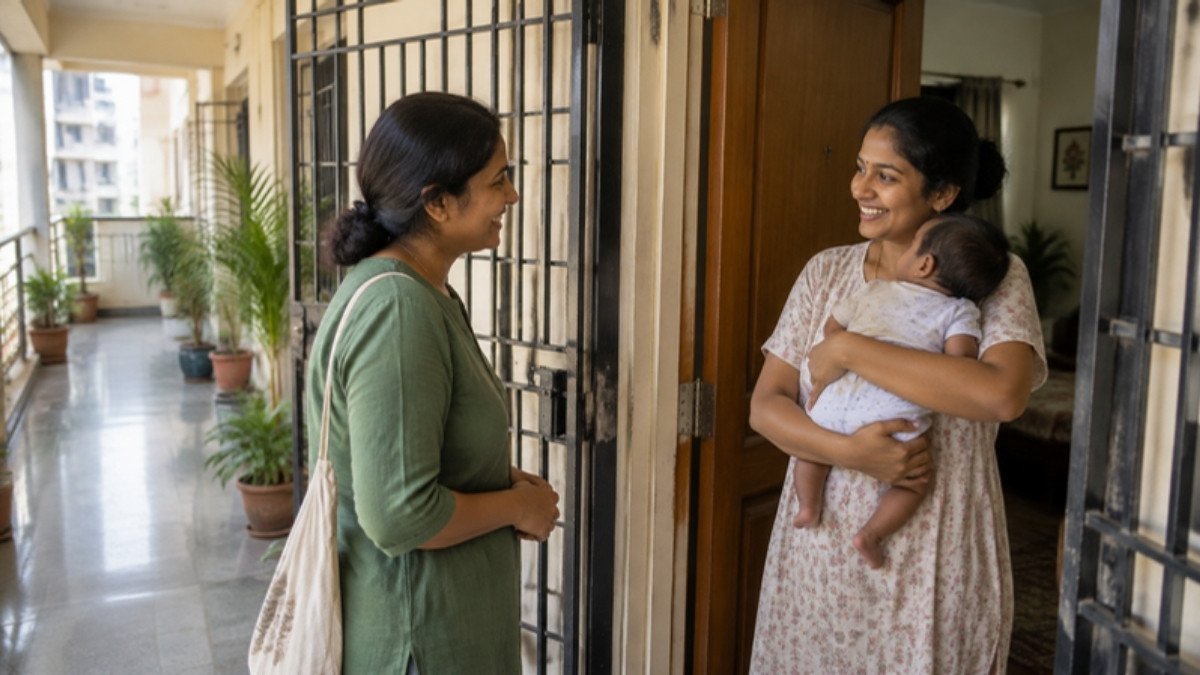
Most apartment communities here use gate security and visitor logs. Ask whether the provider sends staff details in advance so security can approve them. It sounds small. At 7 am with a newborn crying, it is not.
What is the plan for monsoon days and holidays?
Heavy rain, festivals and bandhs can disrupt travel. Ask how missed visits are handled: rescheduled, added to the end, or lost. Get the answer in writing.
What do you need from my home?
Usually a clean, warm room, a firm surface, a towel, hot water for the bath and a bathroom that is safe underfoot. In a flat with a tiled bathroom, a non-slip mat helps. Ask your provider for their list.
Who is the doctor and how do I reach them?
This one is not local, but it is the most important. “Doctor-guided” should mean a named doctor reviews your delivery details and advises when each therapy can begin, particularly after a C-section. If the answer is vague, treat that as information.
Choosing the plan length
Most Bangalore providers sell postnatal care by the number of days. The common choices are one week, two weeks, four weeks and the traditional 40 days. We offer 7, 14, 28 and 40 days. The right length depends on your delivery, your recovery and the help you already have at home.
Families with strong support often start with a week and extend. Mothers recovering from a C-section or a long labour often prefer four weeks, because the early days are the most tiring and the body is still healing for weeks. The full 40 days suits families who want the complete traditional confinement. You do not need to decide perfectly. Ask whether you can add days later and whether the price per day changes if you do.
If cost is your first filter, read what affects the cost of postnatal care before you collect quotes. It explains why two quotes that look alike can cover very different work.

How to compare providers on one sheet
Write each provider’s name at the top of a column and put the same rows down the side. Score each row from 0 to 2 as you talk.
- Who visits, and what training do they have?
- Which doctor advises the plan, and can you speak to them?
- What is included each day, and what costs extra?
- How are hygiene, oils and equipment handled?
- What are the cancellation and refund terms?
- What happens if you or the baby become unwell?
- Can you speak to a past client?
Our longer guide, how to compare postnatal care services, gives the full scorecard and the red flags. The short version: be careful with guaranteed results, the same routine for every mother, pressure to pay in full today, and no written terms.

Ayurvedic postnatal care in Bangalore: what to check
Many families here choose Ayurvedic care because it feels familiar. It may be what their mothers and grandmothers did. That familiarity is a reason to consider it, but it is not proof that any therapy speeds recovery. Traditional use and clinical evidence are different things, and an honest provider will tell you which is which.
Ask who prepares the oils and herbs, what is in them, and whether any have been checked for allergies. Ask whether internal herbal medicines are part of the plan. Those carry more risk than external care, especially if you are breastfeeding, and they need a qualified practitioner and your doctor’s knowledge. Our guide to Ayurvedic postnatal care at home explains what Sutika Paricharya includes and who should adapt it.
When to wait or call your doctor first
Home therapy is not emergency care. Pause and speak to your own doctor before a session if you have a fever, a wound that is red or leaking, heavy bleeding, severe pain, or a swollen, painful calf. After a C-section, therapies near the abdomen need your doctor’s go-ahead. Our C-section recovery guide covers what is normal and what is not.
Seek urgent medical help for heavy bleeding, fever, foul-smelling discharge, chest pain, breathlessness, a severe headache or vision changes, or thoughts of harming yourself or the baby. Do not wait for the next visit.
A simple plan for the next seven days
If you are still deciding, here is a sequence that keeps it manageable. On day one, write down your locality, delivery type, due date and the help you have. On day two, call three providers and ask the same questions. On day three, ask for written scope, terms and the doctor’s name. On day four, speak to one past client if you can. On day five, check registrations and ask about visit times. On day six, choose, and confirm the start date and a backup plan. On day seven, tell your own doctor which service you chose.
You can also use the first-time mother checklist to see what else to arrange before the baby arrives.
Where Sutika Home fits in
Sutika Home provides doctor-guided, Ayurveda-informed postnatal care at home for 7, 14, 28 or 40 days, after a normal delivery or a C-section. A trained therapist visits daily at a time that suits you, and you can follow your visits in the Sutika Home app. Our team is available Monday to Saturday, 9 am to 8 pm.
Coverage depends on your area, so please tell us your locality when you call. If we cannot reach you, we will say so. Use the same questions on us that you use on everyone else. You can request a call back and bring your list.
Conclusion
Choosing postnatal care in Bangalore comes down to a handful of checks: coverage for your area, a realistic visit time, a named doctor, a written scope and clear terms. Do those and you will have filtered out most of the risk. Everything else is preference, and preference is yours to set.
Ask for what you need, keep your doctor’s appointments, and do not feel you have to choose perfectly in the first week. If you want to talk it through, our team can explain how our plans work and whether we serve your locality.
Frequently Asked Questions
What is postnatal care at home in Bangalore?
It is care for the mother in the weeks after delivery, given in your own home. Typically a trained therapist visits regularly for massage, a herbal bath, abdominal care and diet guidance. It supports your recovery alongside your doctor’s follow-up. It does not replace it.
How do I choose a postnatal care provider in Bangalore?
Compare at least three providers using the same questions: who visits, which doctor advises, what is included, how hygiene is handled, what the cancellation terms are and what happens in an emergency. Confirm they cover your locality before you discuss anything else.
How many days of postnatal care should I book?
It depends on your delivery, your recovery and your support at home. Many families choose 7 or 14 days to start. Mothers after a C-section often prefer 28 days, and some families choose the traditional 40 days. Ask whether you can extend later.
Is Ayurvedic postnatal care safe after a C-section?
Some external therapies can be adapted after a C-section, but timing matters and your surgeon should approve it first. Massage and binding near the wound are usually delayed. Ask the provider how they adapt care, and follow your own doctor’s advice.
When should I start looking for postnatal care?
Ideally in the third trimester, so you are not deciding from a hospital bed. Many families book a few weeks before the due date and confirm the start date after delivery. If you are already home with a newborn, you can still arrange care within a few days.
Will the therapist look after my baby too?
Postnatal care is focused on the mother’s recovery. Some providers offer optional baby massage or a baby bath. A nanny or baby-care helper does a different job. Our guide to postnatal care therapist vs nanny explains the difference.
Does postnatal care in Bangalore replace my follow-up appointments?
No. Keep every appointment with your obstetrician and your baby’s doctor. WHO advises further postnatal checks in the first six weeks. Home care should fit around them.
Leave a Reply