


In short: postpartum anxiety is constant worry, restlessness or fear after having a baby that is more than the normal nerves of new motherhood. It can bring a racing heart, trouble sleeping even when the baby sleeps, and repeated “what if” thoughts about the baby’s safety. It is common, treatable and not a character flaw. Talk to your doctor if the worry is on most days, lasts beyond about two weeks, or stops you from resting, eating or caring for yourself and the baby. Seek urgent help for thoughts of harming yourself or your baby.
Every new mother worries. You check that the baby is breathing. You wonder if the feed was enough. You lie awake working out what could go wrong. That is part of being responsible for a tiny person, and it usually eases as you learn your baby.
But for some mothers the worry does not ease. It tightens. The mind will not switch off even when the baby is asleep and the house is quiet. The heart races, the stomach churns, and nothing seems to calm it. If that sounds familiar, this guide explains what postpartum anxiety looks like, how it differs from ordinary worry and from baby blues, who is more at risk, what helps, and when to ask for help. It is general information, not a diagnosis, and a doctor or mental health professional is the right person to assess you.
What is postpartum anxiety?
Postpartum anxiety is a pattern of excessive worry, fear or tension in the weeks and months after birth. It can happen on its own or alongside postpartum depression. The NHS lists feeling “fearful, anxious or worrying all the time” among the symptoms of postnatal depression, and notes that symptoms can start during pregnancy, soon after birth, or any time up to a year afterwards. Anxiety after birth is not always about depression, though. Some mothers do not feel sad at all. They feel on edge.
Doctors call this period “perinatal”, covering pregnancy and the first year after birth. Mental health problems in this window are common, and they are not a sign that you are failing as a mother.
Normal new-parent worry or postpartum anxiety?
There is no sharp line, but a few questions help.
- Does the worry come and go, or is it there most of the day, most days?
- Can you be reassured? Normal worry settles when you check the baby or hear from the doctor. Anxiety returns within minutes.
- Does it stop you from sleeping when you have the chance, eating, or doing things you used to manage?
- Does it last longer than about two weeks? Baby blues usually fade within two weeks. Anxiety that keeps going beyond that deserves a conversation with your doctor.
- Is it getting in the way of caring for your baby, for example you cannot leave the baby with anyone, or you check constantly through the night?
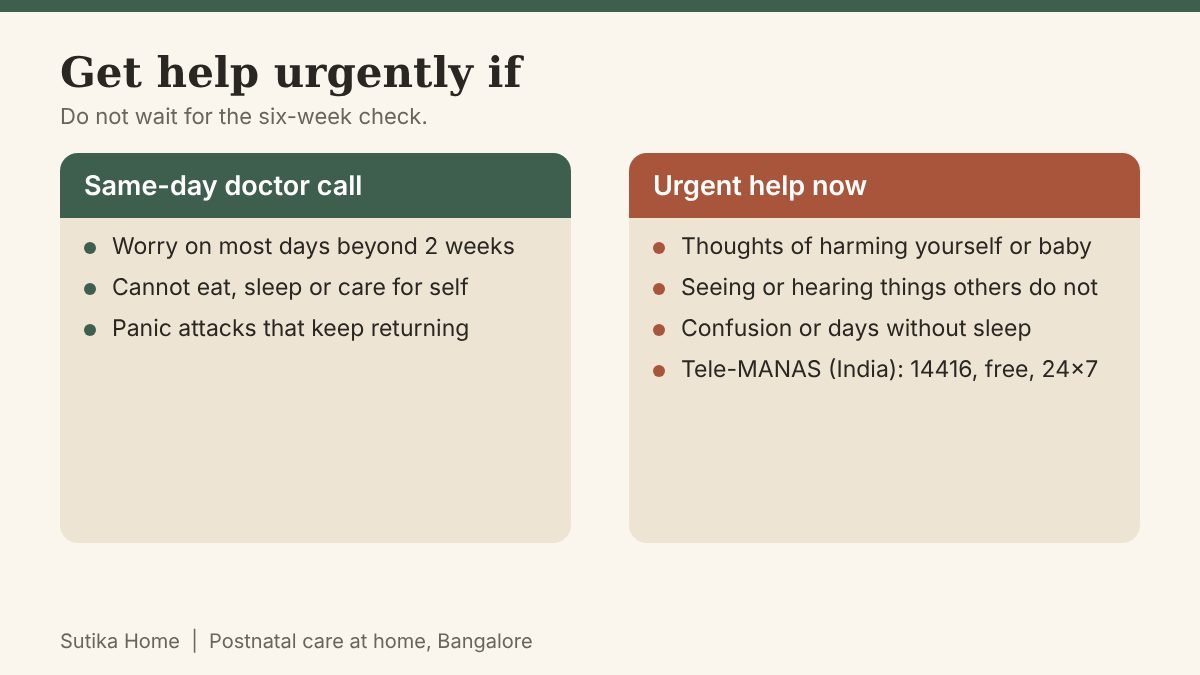
If you answered yes to several of these, mention it at your next appointment or call your doctor sooner. You do not need to wait for the six-week check.
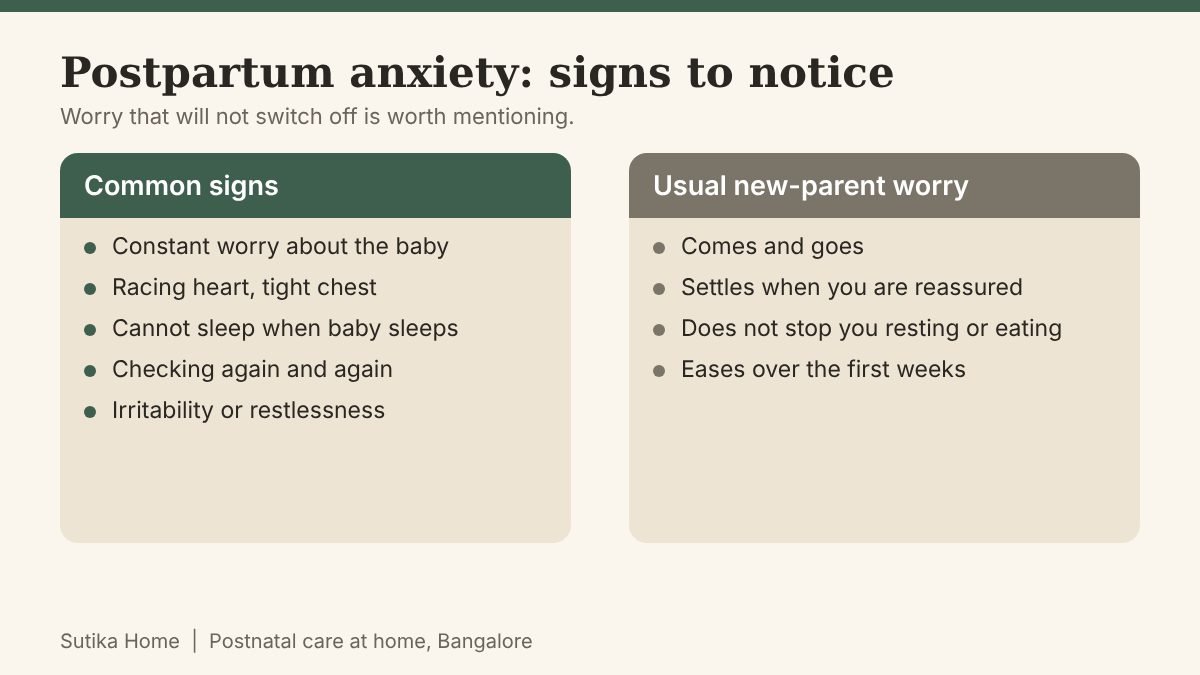
Common signs of postpartum anxiety
Anxiety shows up in the mind and in the body. You may notice some of these.
- Constant worry that something bad will happen to the baby, or to you.
- Racing or pounding heart, tight chest, shortness of breath, dizziness, tingling or sweating.
- Restlessness, feeling keyed up, being unable to sit still or relax.
- Trouble falling asleep or staying asleep, even when the baby is asleep.
- Irritability, snapping at family, or feeling tearful for no clear reason.
- Stomach upset, nausea, loss of appetite, or tension headaches.
- Checking behaviours, such as repeatedly checking the baby’s breathing, the stove, the door or the baby’s temperature.
- Avoiding things, such as not leaving the house, not letting others hold the baby, or avoiding bathing or feeding the baby because of fear.
- Difficulty concentrating or making simple decisions.
Some mothers also have unwanted, frightening thoughts or images, such as the baby slipping from their arms or being harmed. These thoughts can feel shocking. They are more common than most people realise, and having them does not mean you want to act on them. Still, please tell a doctor. Thoughts of harming your baby or yourself, especially if they feel hard to control or come with feeling disconnected from reality, need prompt professional attention.
Postpartum anxiety, baby blues and postpartum depression
These are related but not the same.
- Baby blues: tearfulness, mood swings and feeling overwhelmed in the first days after birth, usually fading within about two weeks.
- Postpartum depression: low mood, loss of interest, guilt, hopelessness, and difficulty bonding, lasting beyond two weeks. The NHS says it can begin up to a year after birth.
- Postpartum anxiety: persistent worry, tension and physical symptoms. It can exist without sadness, and it can also come with depression.
If you are not sure which one fits, our guide on baby blues vs postpartum depression walks through the differences and where to get help. You do not need to work out the label before you ask for support.
Why does it happen?
There is rarely one cause. Hormones shift sharply after delivery. Sleep is broken. Your body is recovering from labour or surgery. There is a new person who depends on you completely. The NIMH adds that personal or family history of depression or other mood problems, high life stress and trauma can raise risk.
Some factors in the Indian context are worth naming. Many mothers go to their parents’ home or return to a nuclear household with little help, and some feel they must not complain because family is “already doing so much”. Pressure to breastfeed perfectly, comments about the baby’s weight or colour, and the expectation to resume household roles quickly can all feed anxiety. If you are managing without elders nearby, our article on postnatal care for nuclear families looks at how to organise help. A traumatic delivery, a baby in the NICU, a loss in the past or a long wait to conceive can also make fear about the baby’s safety stronger.
Physical causes can mimic anxiety, so a doctor may check for things like anaemia or a thyroid problem. Postpartum thyroid changes can cause a racing heart and nervousness, and anaemia can cause breathlessness and palpitations. Our guide to postpartum anaemia explains the signs and testing.
What helps
The NHS notes that postnatal depression and anxiety usually improve within three to six months, though it can last longer, and that treatment makes recovery more likely. Support usually includes a mix of practical help, self-care and professional treatment.
Talk to someone first
Tell a person you trust, whether that is your partner, a friend or your mother. Then tell your doctor, your obstetrician or your baby’s paediatrician. You do not need to have all the right words. “I have been very anxious since the baby came and I cannot switch it off” is enough.
Professional treatment
Talking therapies such as cognitive behavioural therapy are a common first step. Some people also benefit from medicine, and the NHS notes that many antidepressants are considered safe while breastfeeding. Never stop or start medicine on your own. Your doctor can weigh the options with you, including how they fit with breastfeeding.
Protect sleep where you can
Sleep loss makes anxiety worse, and anxiety makes sleep harder. Try to get one longer block of sleep a day, even if someone else gives a feed or the baby sleeps beside a trusted adult. Our guide to postpartum sleep has practical ways to do this.
Eat, drink and move gently
Regular meals, water and short walks, when your doctor says you are ready, steady the body. Tea and coffee in large amounts can worsen palpitations, so consider cutting back. Alcohol and recreational drugs make anxiety worse and are best avoided.
Cut the loop of checking and searching
Late-night internet searches feed worry. Pick one or two trusted sources, such as your paediatrician and the information your hospital gave you, and agree what you will check and when. If you notice you are checking the baby many times an hour, that is a good thing to mention to a professional.
Slow breathing and grounding
When your chest tightens, try breathing in slowly through the nose for about four counts and out through the mouth for about six. Then name five things you can see and four you can touch. These do not cure anxiety, but they can bring the wave down enough to function.
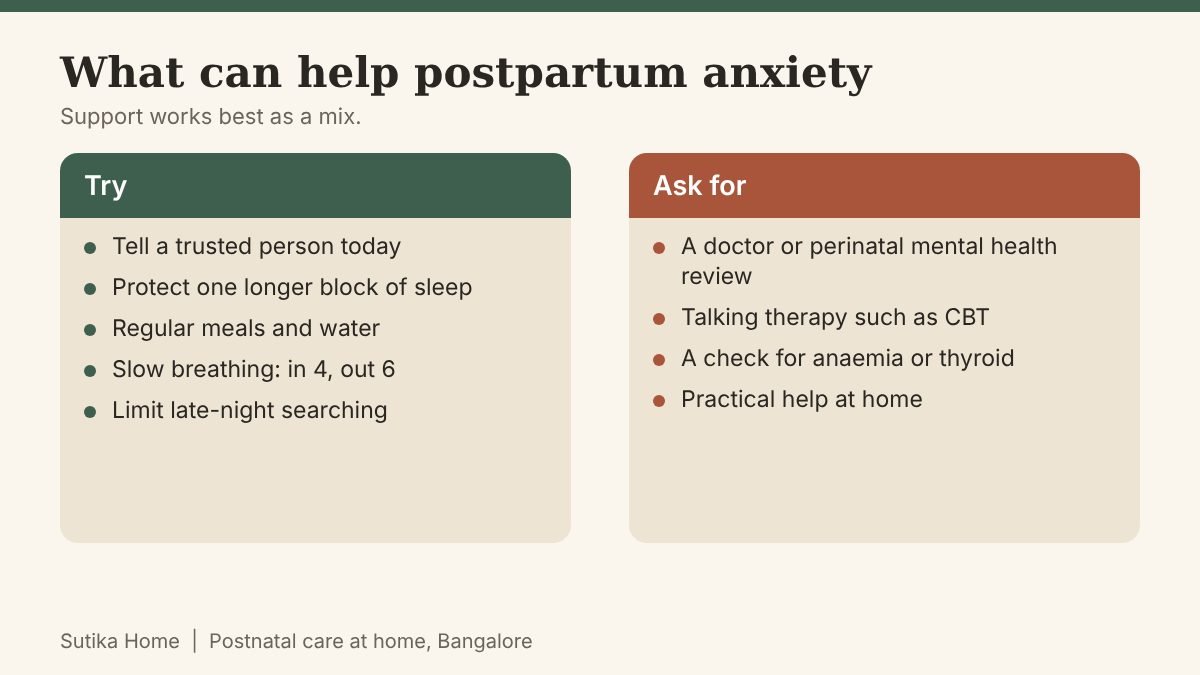
Let someone else take a shift
Handing the baby to a trusted adult for a few hours is not abandonment. It is how recovery happens. If you do not have family close by, a trained postnatal helper can take care of your body’s needs while you rest, which leaves less to worry about.
When to get help urgently
Please seek urgent help and do not wait for a scheduled appointment if you have any of these.
- Thoughts of harming yourself, or of harming your baby.
- Feeling that you cannot cope or that your family would be better off without you.
- Hearing or seeing things others do not, strong confusion, or being unable to tell what is real.
- Not sleeping for days without feeling tired, extreme restlessness, or racing thoughts.
- Being unable to look after yourself or the baby.
These can be signs of a serious condition, including postpartum psychosis, which is a medical emergency. Go to the nearest hospital emergency department or call local emergency services. In India you can also call Tele-MANAS, the government’s free mental health helpline, on 14416, which runs around the clock. Stay with someone while you wait for help, and ask them to take over the baby’s care if needed.

How family and partners can support
Partners and relatives often do not know what to say. A few simple actions help more than advice.
- Ask “how are you really feeling?” and listen without fixing.
- Take night shifts so she can sleep, including expressed milk feeds if that is working.
- Handle meals, laundry and visitors so she is not hosting while recovering.
- Do not dismiss worry as “overthinking” or compare it with how others coped.
- Offer to go with her to the doctor.
- Learn the urgent signs above, and act on them quickly.
Where postnatal care at home fits in
Postnatal care at home cannot treat anxiety, and it is not a replacement for a doctor or therapist. What it can do is reduce the load that makes anxiety heavier: a predictable daily visit, warm food guidance, rest while someone cares for your body, and a person who notices when you are not coping and encourages you to see your doctor.
At Sutika Home, postnatal care at home means daily visits from a trained therapist for traditional Ayurvedic therapies and diet guidance, with care guided by a doctor and adapted to your delivery and recovery. If you are worried about your mood, tell your own doctor first, and let our team know so that the visits can be planned around your rest and appointments. You can contact us to talk through your delivery date and area, and our overview of postnatal care at home explains what to expect.
Frequently Asked Questions
Is postpartum anxiety common?
Yes. Mental health problems after birth are common, and anxiety can occur with or without depression. Because many mothers keep quiet about it, it is often missed. If you recognise yourself in this guide, you are not alone.
How long does postpartum anxiety last?
It varies. The NHS says postnatal depression and anxiety usually improve within three to six months, though some women take longer. Treatment and support make recovery more likely, so do not wait to see if it passes.
Can postpartum anxiety start months after birth?
Yes. The NHS notes symptoms can begin during pregnancy, soon after birth or up to a year later. A new stress, such as returning to work or stopping breastfeeding, can bring it on.
Is it normal to have scary thoughts about the baby getting hurt?
Unwanted frightening thoughts or images are reported by many new parents. They do not mean you want to harm your baby. Still, mention them to a doctor, and seek urgent help if you feel you might act on them or cannot control them.
Can anxiety medicine be taken while breastfeeding?
Some medicines are considered compatible with breastfeeding, but this depends on the medicine and your situation. Always ask your doctor. Do not start or stop a medicine yourself.
What is the difference between anxiety and a panic attack after birth?
A panic attack is a sudden surge of intense fear with a pounding heart, breathlessness, sweating and shaking, usually peaking within minutes. Anxiety is a longer-lasting state of worry. Panic attacks can happen with postpartum anxiety. Chest pain or breathlessness after delivery should always be checked by a doctor, because other causes need to be ruled out.
Who should I call first?
Start with your obstetrician, family doctor or paediatrician, or the doctor who did your delivery. If you are in crisis, go to an emergency department or call Tele-MANAS on 14416.
Leave a Reply